Key Takeaways
- Core expansion reaches 90% within 4 to 6 hours, but full structural density, corner fill, and published firmness ratings take 24 to 72 hours.
- Cold ambient temperatures dramatically slow expansion due to the viscoelastic nature of polyurethane foams; warming your bedroom to 70°F speeds recovery.
- Sleeping on a half-expanded bed risks bottoming out, distorting spinal alignment, and permanently warping cell walls in uncured foam layers.
- VOC off-gassing harmlessly peaks within 24 hours; active cross-ventilation and keeping mattress protectors off during initial decompression speeds odor clearance.
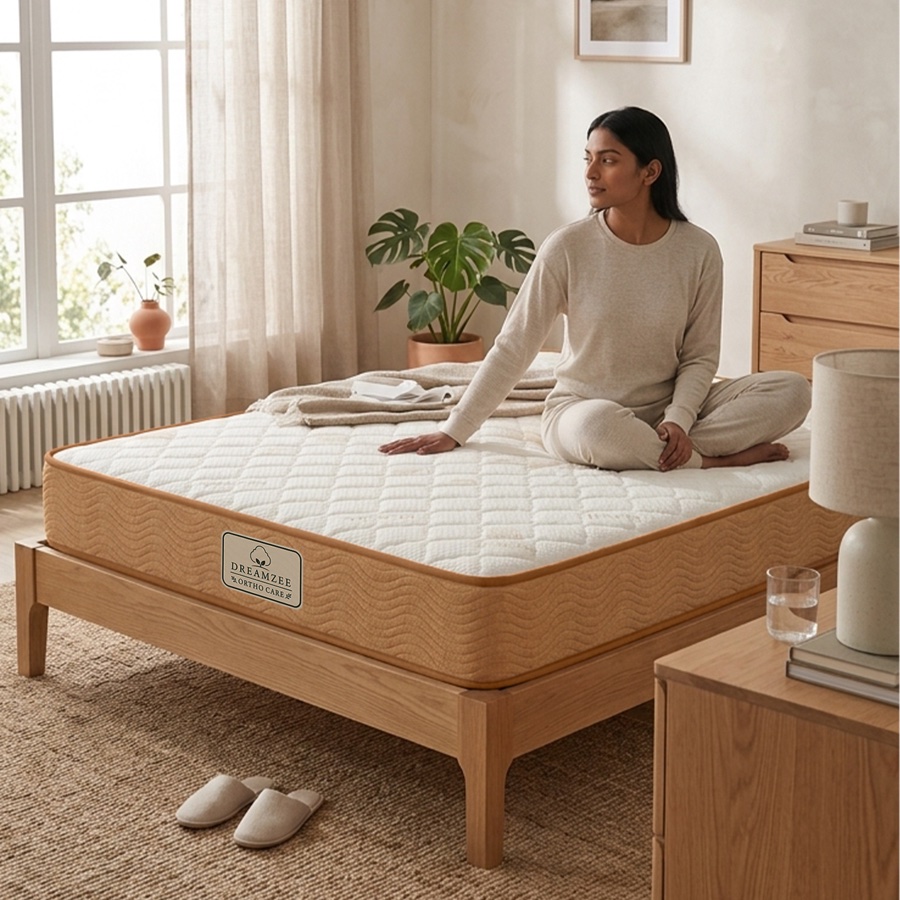
The moment you slice open the vacuum-sealed polyethylene wrapping on a modern bed-in-a-box, atmospheric pressure immediately forces air into crushed polyurethane cells. While some beds featured in our Best Mattress 2026 roundup snap visibly to life in seconds, true physical decompression is a gradual mechanical process. Unlike traditional innersprings delivered flat by white-glove couriers—such as the Saatva Classic—compressed beds must rebuild their internal structural tension from scratch.
Depending on mattress construction, ambient temperature, and material density, a compressed bed takes between 24 and 72 hours to achieve full height, edge stability, and designed firmness. As we often see when analyzing Memory Foam vs. Hybrid Mattresses: Complete Sleep Lab Breakdown, dense memory foams like those inside the Nectar Memory Foam require substantially more time to equilibrate than open-coil hybrid systems. Rushing this process by sleeping on the bed too soon compromises both sleep posture and long-term foam resilience.
The Decompression Timeline: What Happens Over 72 Hours
When a mattress factory rolls a mattress under hundreds of pounds of pneumatic hydraulic pressure, the air inside the cellular matrix is expelled, flattening cell membranes. Once freed from the plastic sleeve, air rushes back into the open-cell structure. However, the foam’s chemical polymers need time to regain elasticity.
Hours 0 to 4: The Rapid Mechanical Rebound
During the initial four hours, the mattress does roughly 85% to 90% of its physical expanding. Pocketed steel coils, like those found in the Helix Midnight Luxe, flex back almost immediately because tempered steel possesses instant mechanical rebound. Low-density polyfoams also inflate rapidly. At this stage, the center of the bed looks nearly normal, though the outer perimeter and corners frequently remain droopy or wrinkled.
Hours 4 to 24: Core Density Stabilization
Between 4 and 24 hours, viscoelastic memory foams slowly recover their original Indentation Load Deflection (ILD). The chemical bonds within dense foams relax from their compressed state. Even though the bed might look fully expanded by hour 12, the internal layers are still noticeably softer than intended. Applying full body weight during this window compresses cell walls before they have re-established their structural tension.
Hours 24 to 72: Corner Fill and Full Firmness Equilibrium
The final stage involves perimeter borders, outer cover fabrics, and stubborn corners. High-density support foams, such as the reinforced base in the WinkBeds Plus, reach their intended load-bearing capacities during this window. At 72 hours, the mattress has completed all thermal and mechanical stabilization.
| Mattress Construction | Initial Expansion (85-90%) | Full Firmness Stabilization | Typical Off-Gassing Duration |
|---|---|---|---|
| All-Polyfoam | 2 to 4 hours | 24 to 48 hours | 24 to 48 hours |
| Dense Memory Foam | 4 to 8 hours | 48 to 72 hours | 48 to 72 hours |
| Pocketed Coil Hybrid | 1 to 3 hours | 24 to 36 hours | 12 to 36 hours |
| Natural Latex Hybrid | 1 to 2 hours | 12 to 24 hours | 0 to 12 hours (mild sweet scent) |

Why Room Temperature and Shipping Delays Alter Expansion Speed
Viscoelastic foam is inherently temperature-sensitive. The glass transition temperature of polyurethane means that when cold, foam stiffens and resists movement. If your mattress traveled inside an unheated freight truck during sub-freezing winter weather, the foam core will arrive semi-rigid.
From the Lab: In our mattress evaluation space, bringing a mattress from a 42°F storage unit into a 65°F room resulted in a 36-hour delay before the corners expanded to within 0.5 inches of spec. Warming that room to 72°F accelerated corner expansion by over 14 hours. Cold foam does not mean damaged foam—it simply means sluggish polymer mobility.
If your bed arrived cold to the touch, do not force it open aggressively. Unroll it flat on your foundation, set your thermostat between 70°F and 72°F, and let ambient warmth penetrate the core before evaluating its thickness.
Can You Sleep on It Right Away? Risks to Your Spine
Most mattress manufacturers state in fine print that you can sleep on the bed after 4 to 6 hours if necessary. While doing so will rarely ruin the mattress permanently, it introduces orthopedic issues.
An under-expanded mattress cannot deliver its rated spinal alignment. When support cores are under-inflated, your heaviest anatomical zones—namely your hips and pelvis—sink past the intended comfort transition layer. This unexpected sagging is a prime culprit behind Hip Pain From Your Mattress? How to Tell If Your Bed Is Too Soft or Too Firm. Furthermore, poor support during expansion disrupts cervical positioning, increasing the odds of waking up with severe discomfort, as detailed in our guide to Neck Stiffness in the Morning: Mattress Edge, Pillow Loft & Spinal Alignment.
If you suffer from chronic lumbar issues and selected a mattress based on criteria from our guide to the Best Mattress Types for Lower Back Pain: What Sleep Lab Data Actually Shows, resting on uncured foam counteracts those ergonomic benefits. If you must sleep on the mattress the first night, understand that it will feel 1 to 1.5 points softer on the 1–10 firmness scale than its true calibrated rating.
Managing Off-Gassing Odors: The Science of VOC Dissipation
That distinct "new mattress smell" is the release of Volatile Organic Compounds (VOCs). VOCs occur when polyurethane foam, memory foam, or adhesives off-gas chemicals like chlorofluorocarbons or polyols trapped during rapid vacuum-packaging. While beds built with organic materials like Plushbeds use natural latex that emits zero synthetic VOCs (only a faint, vanilla-like rubber scent), petroleum-based foams off-gas systematically.
For beds certified by CertiPUR-US or OEKO-TEX Standard 100, these odors are non-toxic, but they can trigger headaches or airway sensitivity in allergy-prone individuals.
To accelerate off-gassing:
- Establish Cross-Ventilation: Place a box fan facing out of an open bedroom window while keeping a second window or bedroom door open. This creates a low-pressure pull that draws VOCs out of the room.
- Keep Bedding Off: Do not put sheets, mattress pads, or water-resistant protectors on the bed during the first 24 hours. Waterproof membranes trap escaping gases directly back into the top comfort layers.
- Knead the Foam: Walking gently across the mattress surface after 12 hours pumps air through the open-cell matrices, flushing out pockets of lingering factory air.
If you prefer beds that skip synthetic foam off-gassing entirely, taking our Sleep Match Quiz can point you toward certified organic and pre-expanded latex alternatives.
Troubleshooting Flat Corners and Uneven Edges
Because mattresses are compressed horizontally and rolled tightly, the deepest compression stress occurs at the head, foot, and corner seams. If your mattress features ultra-plush contouring like the Puffy Lux Hybrid, a pinched corner or sloped edge 24 hours after unboxing is common.
If a corner has not fully rebounded after 48 hours:
* Check the Zippered Cover: Sometimes the outer woven cover twists during vacuum sealing, pinning the foam core down. Unzip or loosen the cover around the stuck corner to allow the foam room to expand.
* Warm-Air Stimulation: Use a standard hair dryer on a medium, low-heat setting held 12 inches away from the squished area. Warm the foam for three to five minutes while gently massaging the corner with your hands to restore cell elasticity.
Frequently Asked Questions
Will sleeping on my mattress before 24 hours void the warranty?
No. Mattress brands understand customers may have nowhere else to sleep. Using the mattress on night one does not void your warranty, provided it sits on a proper, non-sagging foundation. However, doing so can temporarily impede corner recovery and makes the bed feel softer than its design specs.
Why do the corners take longer to expand than the middle?
When rolled for packaging, the corners endure severe multi-axis compression and fold under the tightest radius. The center of the mattress retains greater volume during the roll, while perimeter seams and corners experience the greatest shear stress, requiring up to 72 hours to pull in ambient air.
How can I tell if my mattress is defective and won't expand?
If your mattress has been unboxed at room temperature (above 68°F) for a full 72 hours and remains two or more inches below its advertised height—or has a severely depressed, asymmetrical dip—the foam cells likely sustained crush damage during storage. Contact customer support for a replacement under warranty.

Jessica Moore, Certified Sleep Science Coach
Jessica has spent 8+ years analyzing biomechanics, pressure relief mapping, and mattress ergonomics. She leads our independent sleep lab in Austin, TX, overseeing thermal, motion, and durability testing.