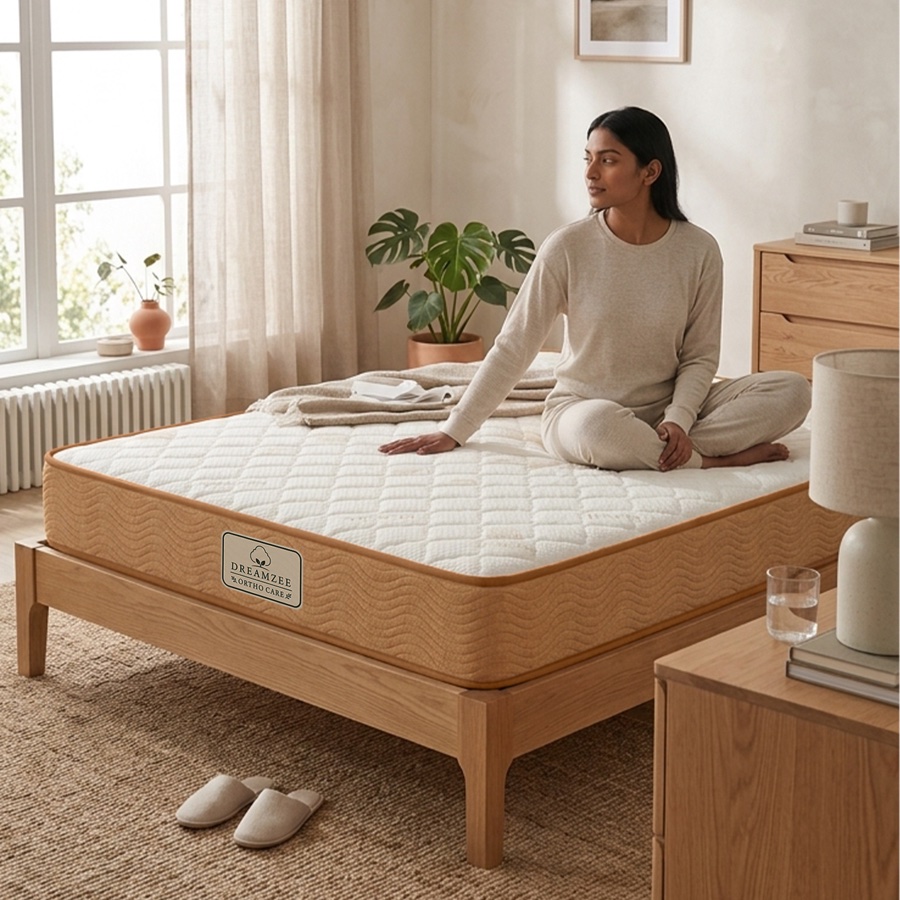
Purple takes the win for superior cooling and responsive spinal support, while Puffy excels at budget-friendly motion deadening.
Purple Original
9.25" GelFlex Grid All-Foam | From $799
- Outstanding airflow with 1,800+ open grid channels
- Zero-lag repositioning for combination sleepers
- Buckling-column tech relieves pressure without deep sinking
Puffy Original
10" Triple-Layer Memory Foam | From $449
- Superior motion isolation for partner disturbance
- Gentle hugging contour ideal for lightweight side sleepers
- Generous 365-night trial and lifetime warranty
Key Takeaways
- Purple features an open-column GelFlex Grid that provides instant response and class-leading temperature neutrality.
- Puffy utilizes a classic, body-contouring memory foam stack that isolates motion exceptionally well for restless couples.
- Hot sleepers and combination sleepers lean heavily toward Purple's breathable, non-temperature-sensitive polymer grid.
- Puffy wins on budget and trial length, offering a 365-night trial and lifetime warranty compared to Purple's 100-night test window.
| Spec / Metric | Purple (Original) | Puffy (Original) |
|---|---|---|
| Firmness Score | Medium-Firm (6.5 / 10) | Medium (6.0 / 10) |
| Mattress Profile | 9.25 inches | 10.0 inches |
| Comfort Layer | 2" Hyper-Elastic GelFlex Grid | 2" Cooling Cloud Memory Foam |
| Cooling Lab Score | 9.5 / 10 (Class Leader) | 8.5 / 10 (Moderate) |
| Motion Isolation | 9.2 / 10 | 9.5 / 10 (Deadens vibrations) |
| Edge Support | 8.5 / 10 | 8.2 / 10 |
| Sleep Trial / Warranty | 100 Nights / 10 Years | 365 Nights / Lifetime |
| Starting Price (Twin) | $799 | $449 |
Choosing between the flagship Purple and the classic Puffy comes down to a fundamental question of comfort material philosophy. While both began as front-runners in the modern best mattress in a box explosion, they deliver two polar opposite surface sensations. One features a proprietary, hyper-elastic polymer grid that flexes beneath prominent joints while remaining resilient along flat planes; the other relies on a plush, pressure-absorbing memory foam envelope engineered to swallow movement entirely.
Shoppers narrowing down their selections often evaluate matchups like Casper vs Purple or Nectar vs Puffy before landing here. Purple offers an active, buoyant floating feel that keeps you resting directly on top of the sleeping surface. In contrast, Puffy delivers the classic viscoelastic embrace that hugs your body into the upper layers. In our mechanical lab testing, we dissected both mattresses across pressure distribution, temperature dissipation, edge durability, and motion dampening to identify which mattress fits your specific biomechanics.
Construction and Core Materials
The construction of these two mattresses explains almost all of their performance differences. The original Purple stands at 9.25 inches tall, constructed around a proprietary 2-inch comfort layer of hyper-elastic polymer molded into a repeating geometric grid. This GelFlex Grid sits over two separate layers of polyurethane foam: a 3.5-inch transition polyfoam and a 4-inch high-density structural base foam. Purple wraps the grid in a border of firmer polyfoam to maintain edge integrity, encasing the entire unit in an ultra-stretchy polyester-spandex blend that permits the grid to buckle freely beneath your body.
Puffy takes an all-foam approach across a 10-inch profile. The sleep surface features a 2-inch layer of Puffy's "Cooling Cloud" gel-infused memory foam, followed by a 2-inch "Climate Comfort" polyfoam transition layer. The foundation is a 6-inch core of high-density base foam designed to resist sagging. Unlike the pocketed coils seen in premium hybrid options such as the Purple Hybrid or the plush Puffy Lux Hybrid, both of these base models rely entirely on high-density foam foundations to provide stability.
Pressure Relief and Spinal Alignment
Pressure relief is where individual body geometry dictates the clear winner. The Purple grid works on buckling-column mechanics: when weight exceeds a certain threshold—such as under your hips or shoulder blades—the walls of the polymer columns buckle inward, eliminating pressure peaks. Where your body spreads weight across a broader surface area, such as your lower back or thighs, the grid maintains its structural columns to hold your spine in horizontal alignment. During our surface mapping tests, back sleepers recorded near-zero pressure around the lumbar spine, making Purple a staple recommendation among our best mattress for back pain assessments.

Puffy achieves pressure redistribution through viscoelastic rate-dependent response. When you lie down, your body heat and mass slowly compress the Cooling Cloud foam, allowing you to sink gently into the material. For side sleepers under 180 pounds, Puffy provides an exceptionally plush nest that cushions the acromion process (tip of the shoulder) and greater trochanter (hip bone). However, our heavier testing team members (above 230 pounds) noted that Puffy's top foams compressed completely to the firm support core, producing slight lumbar dipping when resting on their backs.
Motion Transfer and Couple Dynamics
If you share your bed with a restless partner or an active pet, motion isolation is paramount. In our drop-weight tests using calibrated sensors, Puffy demonstrated near-total vibration absorption. Memory foam naturally dissipates kinetic energy because its cellular matrix converts motion into microscopic heat rather than bouncing it backward. Puffy routinely ranks among our favored choices on the best mattress for couples list for light sleepers who wake at every minor shift.
Purple isolates motion respectably well—scoring 9.2 out of 10 on our test bench—because each grid column flexes independently without dragging adjacent walls along with it. However, the rubbery polymer possesses genuine elasticity. When a 20-pound kettlebell drops from a 12-inch height, our seismic readouts detected minor high-frequency rebound vibrations that traveled across the cover. It does not carry the wide-scale disturbance of an innerspring core, but it lacks the deadening sensation that Puffy produces.
Temperature Regulation
Thermal dissipation represents the single widest performance canyon between these two beds. Memory foam is an insulator by nature. Even with gel infusions and phase-change cover treatments, Puffy's close-contact contouring traps ambient body warmth against the torso over hours of continuous rest. In our thermal imaging camera trials, Puffy retained surface warmth above 88°F for nearly 12 minutes post-occupancy, scoring an 8.5 out of 10.
Purple scored an extraordinary 9.5 out of 10. Because the GelFlex Grid consists of open air columns—roughly 80 percent of the comfort layer is empty vertical channels—heat generated by the body does not get trapped within dense foam cells. Instead, excess warmth flows effortlessly through the grid and escapes through the breathable stretch cover. Furthermore, hyper-elastic polymer is inherently temperature-neutral; it will not soften in warm summer rooms or turn rigid in winter conditions, a drawback common to classic foam explored in our Purple vs Tempur-Pedic testing.
Edge Support and Ease of Movement
Bed-in-a-box mattresses constructed without steel coils often struggle with perimeter stability. Puffy compresses substantially when sitting directly along the outer edge to tie shoes or when sleeping near the perimeter. Our displacement gauge measured 3.6 inches of perimeter depression under a 180-pound load.
Purple integrates a continuous high-density polyurethane perimeter ring around the GelFlex Grid to shore up its edges. This reinforcement keeps edge sinkage to 3.1 inches, providing more usable sleeping real estate. Where Purple pulls far ahead is ease of movement: changing positions on Purple requires minimal physical effort because the grid springs back instantaneously. On Puffy, the slow-melting memory foam creates a mild "quicksand" sensation, requiring noticeably more core effort to roll from stomach to side.
Unboxing, Trial, and Long-Term Warranty
Both mattresses ship compressed in compact boxes. Once released from the vacuum plastic, you can read our guide on how long does a mattress in a box take to expand to manage expectations during setup. Puffy exhibits a standard polyfoam off-gassing scent for roughly 36 to 48 hours, while Purple carries a faint rubber-like polymer odor that dissipates within a day.
Where Puffy scores major consumer value points is risk mitigation. Puffy backs their bed with a 365-night home sleep trial and an unlimited lifetime warranty. Purple provides an industry-standard 100-night trial backed by a 10-year limited warranty. If you want a full four-season evaluation period before locking in your purchase, review our breakdown on understanding mattress sleep trials to see how Puffy's generous window stands out against competitors like the Nectar vs Purple offerings.
Final Verdict: Which Should You Choose?
Choose the Purple if you sleep warm, switch positions frequently throughout the night, or want buoyant spinal support that keeps your hips elevated without sacrificing joint cushioning. It is an ideal fit for back and combination sleepers seeking maximum airflow.
Choose the Puffy if you crave deep body hug, need absolute motion dampening to sleep undisturbed alongside a partner, or want maximum warranty protection on a tighter budget. Lightweight side sleepers will find Puffy's classic memory foam contouring exceptionally cozy.
Frequently Asked Questions
Does the Purple grid feel strange to sleep on?
The GelFlex Grid does feel unusual for the first 3 to 7 nights. Instead of sinking into pillowy foam or resting on firm padding, it feels somewhat like floating on a supportive silicone pad. Most sleepers adjust quickly once their lower back muscles relax into the buoyant alignment.
Can side sleepers comfortably use the original Puffy?
Yes, provided they weigh under 200 pounds. Puffy's medium firmness (6.0/10) allows the shoulders and hips to compress the top two foam layers, preventing pressure build-up. Sleepers over 200 pounds, however, will likely bottom out into the support core and need a thicker hybrid profile.
Do either of these mattresses need a box spring?
Neither Purple nor Puffy requires a traditional box spring; in fact, traditional flexible box springs can damage foam foundations. Both mattresses perform best on a solid platform, an adjustable base, or a slatted frame with rigid slats spaced no more than 3 to 4 inches apart.
Jessica Moore, Certified Sleep Science Coach
Jessica has spent 8+ years analyzing biomechanics, pressure relief mapping, and mattress ergonomics. She leads our independent sleep lab in Austin, TX, overseeing thermal, motion, and durability testing.