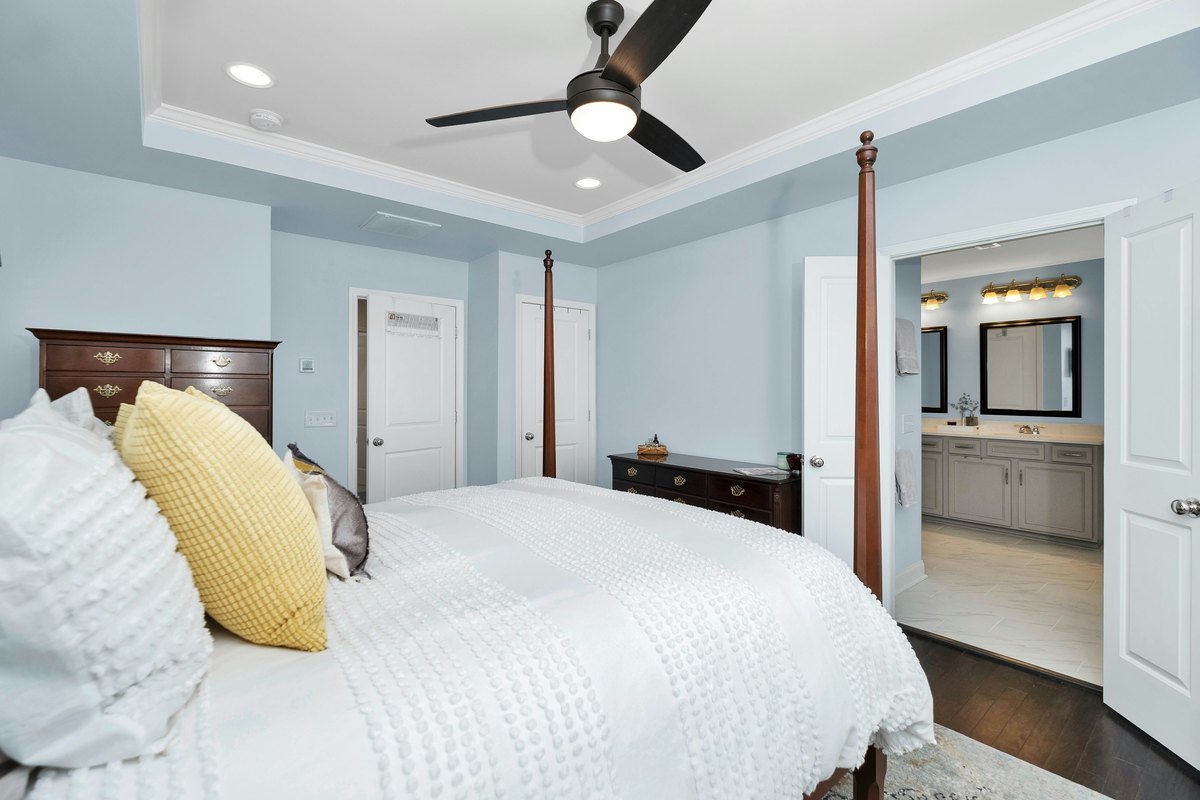
Saatva wins on value, cooling, and lumbar support, while Tempur-Pedic remains the king of motion deadening and pressure relief.
Saatva Classic
Dual-Coil Hybrid | Starting at $1,095
- Exceptional airflow and cooler sleep surface
- Unrivaled 365-night home trial and lifetime warranty
- Active spinal alignment with reinforced lumbar zone
Tempur-Pedic (TEMPUR-Adapt)
Proprietary Viscoelastic | Starting at $1,699
- Class-leading motion isolation for restless partners
- Deep, contouring body hug that melts away joint pain
- Long-standing clinical reputation for pressure relief
Key Takeaways
- Saatva Classic offers responsive, buoyant support with superior edge firmness (9.9/10) and airflow, making it ideal for combination sleepers and back pain sufferers.
- Tempur-Pedic provides benchmark-grade motion isolation (9.9/10) and deep contouring that eliminates acute pressure peaks at the hips and shoulders.
- Saatva wins significantly on trial length (365 nights vs 90 nights), warranty (Lifetime vs 10 years), and starting price ($1,095 vs $1,699).
- Tempur-Pedic runs noticeably warmer due to its ultra-dense open-cell foam formulation, whereas Saatva's dual-coil design circulates ambient air continuously.
| Feature / Metric | Saatva Classic | Tempur-Pedic (Adapt Series) |
|---|---|---|
| Mattress Construction | Dual-coil innerspring hybrid with Euro pillow top | Proprietary TEMPUR viscoelastic foam (or hybrid) |
| Firmness Levels | Plush Soft (3), Luxury Firm (6.5), Firm (8) | Soft (3.5), Medium (5.5), Firm (7.5) |
| Motion Isolation Score | 9.2 / 10 (Controlled bounce) | 9.9 / 10 (Near total absorption) |
| Thermal Regulation Score | 9.8 / 10 (Open dual-coil airflow) | 8.7 / 10 (Dense foam retains heat) |
| Edge Support Rating | 9.9 / 10 (High-density foam encasement) | 8.8 / 10 (Noticeable compression under load) |
| Trial Period | 365 nights ($99 return fee) | 90 nights (Customer pays return shipping) |
| Warranty | Lifetime warranty | 10-year limited warranty |
| Starting Price (Twin/Queen) | $1,095 / $2,095 | $1,699 / $2,199 |
Evaluating the Saatva Classic against the flagship Tempur-Pedic collection is a battle between two fundamentally different engineering philosophies. Saatva champions a buoyant, dual-coil architecture topped with an organic cotton Euro pillow top, specifically built to maintain spinal neutrality. In contrast, Tempur-Pedic utilizes NASA-developed viscoelastic foam formulations calibrated to respond to ambient body heat, slowly yielding until every point of body weight is suspended in zero-gravity immersion. Both brands consistently appear on our roundup of the Best Mattress for Back Pain, yet the tactile sensation of sleeping on them could not be more polarized.
Selecting between them is rarely a question of craftsmanship; both occupy the upper echelon of domestic mattress manufacturing. Rather, it comes down to how your body responds to sinking versus floating, your thermal preferences during deep sleep stages, and whether you share your bed with an active partner. If you are shopping the luxury tier and cross-referencing options on our guide to the Best Mattress for Couples, understanding how each surface manages kinetic energy and localized pressure is critical before committing your budget.
Construction and Feel: Active Coil Lift vs. Slow-Sinking Hug
The architectural divergence begins at the foundation. The Saatva Classic pairs a lower base of 13-gauge tempered steel support coils with an upper tier of individually wrapped 14.5-gauge pocket coils. Over these springs sits a patented Active Support Wire and a central lumbar pad made from high-density memory foam, capped by a 3-inch quilted Euro pillow top. This configuration creates an "on-top-of-the-bed" sensation. You feel pushed upward with immediate resistance, allowing you to turn over effortlessly. Saatva also produces specialized models like the Saatva RX for chronic joint problems and the Saatva Latex Hybrid for eco-conscious sleepers, but the Classic remains the benchmark for dual-coil engineering.
Tempur-Pedic relies on its proprietary TEMPUR material—an ultra-dense (typically 4.5 to 5.3 lbs/cu ft) polyurethane-based viscoelastic foam. When you lie down on a TEMPUR-Adapt or TEMPUR-ProAdapt, the mattress does not push back immediately. Instead, your natural body heat softens the cell walls of the foam over a 30- to 60-second window, prompting a gradual descent. This "in-the-bed" feeling eliminates gaps beneath the lower back and cradles the shoulder girdle. However, it also creates a subtle trench effect; switching positions requires slightly more muscular effort than it does on a responsive hybrid.

Thermal Regulation and Heat Retention
Thermal performance is one of the starkest differentiators between these two luxury contenders. Our thermal imaging tests record the rate of surface cooling over a 60-minute window following a human subject's exit from the bed.
The Saatva Classic scored an exceptional 9.8/10 for cooling. Because roughly 80% of the mattress interior consists of open air within two separate coil systems, ambient bedroom air circulates freely with every positional shift. The organic cotton cover is treated with Guardin botanical antimicrobial protection and breathes effortlessly, preventing hot air from trapping beneath the torso. Even very warm sleepers reported stable, comfortable sleep climates across full eight-hour test windows.
Tempur-Pedic models, despite proprietary cooling covers and phase-change coatings on higher trims like the LuxeBreeze, inherently face the physical limitations of high-density viscoelastic foam. Standard Tempur models scored 8.7/10 in our thermal lab. The closed-cell structure required for that classic contouring naturally traps metabolic body heat over prolonged periods. If you burn hot at night, you may find yourself migrating toward the cooler outer edges of the mattress unless you invest in their specialized, significantly more expensive Breeze series, a compromise discussed further in our Purple vs Tempur-Pedic head-to-head analysis.
Motion Transfer and Pressure Relief
If motion isolation is your paramount objective, Tempur-Pedic remains the unmatched industry standard. When we dropped a 15-pound kettlebell from a height of three feet onto one side of the TEMPUR-Adapt, the digital accelerometer on the adjacent side barely registered a trace, yielding a 9.9/10 score. The viscoelastic foam deadens kinetic vibrations at the molecular level. A partner tossing, turning, or getting up to use the restroom will not generate the reverberations typical of steel springs.
Saatva handles motion admirably for a spring-based construction (9.2/10), largely because its upper tier uses pocketed coils that compress independently. However, the continuous lower innerspring unit still transmits subtle energy pulses across the perimeter. Light sleepers who share a bed with an erratic sleeper will notice a distinct difference here.
Conversely, Saatva counters with world-class targeted lumbar alignment. For back and stomach sleepers needing a crisp, supportive surface, the Luxury Firm and Firm options match well against competitors in our Saatva vs Beautyrest evaluation, preventing the pelvis from dipping below the plane of the thoracic spine. Side sleepers seeking extreme joint cushioning, however, will likely find Tempur-Pedic's slow contouring superior for dispersing peak pressure points at the lateral trochanter (hip bone) and acromion process (shoulder).
Edge Support and Functional Sleep Surface
Edge integrity dictates how much usable sleep surface a mattress actually provides. Saatva integrates a dedicated high-density foam encasement perimeter surrounding both spring units. In our laboratory edge-deflection tests, the Saatva Classic compressed a negligible 2.8 inches under full adult body weight along the perimeter, earning a near-perfect 9.9/10 score. You can sit directly on the side of the bed to put on your shoes without rolling off, and couples can maximize the entire surface from edge to edge.
Tempur-Pedic’s all-foam bases compress more readily under localized perimeter stress, registering 4.1 inches of sinkage during the same test (8.8/10 rating). While the hybrid variations of Tempur-Pedic fare slightly better due to perimeter coil rings, you still experience a gradual sliding sensation when perching directly on the edge of the mattress for extended periods.
Trial Policies, Warranty, and Value
From a consumer-rights perspective, the ownership experience heavily favors Saatva. Saatva provides an industry-leading 365-night home trial accompanied by a lifetime warranty. Saatva does deduct a flat $99 processing fee if you decide to initiate a return, but their customer support and in-home white-glove delivery come standard. Before purchasing either brand, we strongly advise reading our guide on Understanding Mattress Sleep Trials: Break-In Periods & Hidden Return Fees.
Tempur-Pedic offers a standard 90-night trial, requiring you to test the mattress for at least 30 nights to allow the foam to break in. Returns require you to cover shipping fees, which can run upwards of $175 to $250 depending on carrier logistics. Tempur-Pedic backs their mattresses with a 10-year limited warranty requiring indentations of at least 0.75 inches for claims. To protect your investment, see our detailed explainer on How to Read a Mattress Warranty (And What Actually Voids Your Coverage).
Note also the difference in height profiles: Saatva offers 11.5-inch and 14.5-inch versions, so consult our Deep-Pocket Fitted Sheets Guide: Matching Sheet Depth to 12"–16" Mattresses to make sure your bedding fits properly without popping off the corners.
Final Verdict: Which Should You Buy?
Choose the Saatva Classic if you want responsive support, traditional innerspring bounce, exceptional perimeter durability, and naturally cool sleep temperatures at a consumer-friendly price point. It represents one of our top recommendations in the Best Firm Mattress category for those who refuse to feel trapped in their bed.
Choose Tempur-Pedic if you struggle with chronic shoulder and hip pressure peaks, prefer deep, body-molding contouring, and prioritize complete, near-flawless motion isolation above all other performance variables.
Frequently Asked Questions
Does the Saatva Classic sag over time compared to Tempur-Pedic?
Both brands display high structural longevity. Saatva uses a heavy-duty 13-gauge recycled steel base coil that resists sagging far better than entry-level polyfoam bases. However, Tempur-Pedic's high-density proprietary foam is renowned for its fatigue resistance over decade-long lifespans. Regular 180-degree head-to-toe rotation every six months ensures even wear on both designs.
Can I use an adjustable base with both the Saatva Classic and Tempur-Pedic?
Yes. Tempur-Pedic all-foam and hybrid models are famously engineered to articulate seamlessly on adjustable power bases. The Saatva Classic is also compatible with adjustable bases, but you must select the 11.5-inch profile; the taller 14.5-inch profile is too thick to bend comfortably on an articulating frame.
Why is Tempur-Pedic significantly more expensive than Saatva?
Tempur-Pedic maintains a traditional retail distribution network with third-party brick-and-mortar storefronts, higher dealer margins, and proprietary foam manufacturing patents. Saatva operates predominantly via a direct-to-consumer online business model, eliminating dealer markups while offering free in-home white glove delivery.

Jessica Moore, Certified Sleep Science Coach
Jessica has spent 8+ years analyzing biomechanics, pressure relief mapping, and mattress ergonomics. She leads our independent sleep lab in Austin, TX, overseeing thermal, motion, and durability testing.



