Key Takeaways
- Medium-firm wins clinical & lab benchmarks: 6.0–7.0/10 mattresses consistently maintain neutral lumbar alignment better than extra-firm slabs.
- Zoned center-third support prevents heavy hips from sinking lower than your ribcage overnight.
- Stiff, unyielding boards force your lumbar muscles to brace all night instead of relaxing.
- Models like Saatva Classic and Nolah Evolution 15 combine cushioned tops with active lumbar steel support.
If your lower back feels locked up for the first forty minutes every morning—then gradually loosens once you pour coffee and walk around—your spine probably spent the night fighting your mattress.
For decades, shoppers dealing with lumbar ache got the same reflex advice from showroom clerks and well-meaning relatives: buy the firmest mattress you can stand. On paper, it sounds logical. If your back hurts, a stiff, unyielding surface ought to hold everything straight.
Inside our Austin sleep laboratory, thirty-night trials and high-resolution pressure sensors tell a far more nuanced story. Pure 9/10 "extra-firm" slabs regularly scored worse for morning lumbar tension than balanced medium-firm hybrids—and clinical sleep trials back that up. Here is why extreme firmness fails, what construction actually protects your lower spine, and how to pick the right bed for your weight and sleep position.
Why "Extra-Firm" Mattresses Often Make Back Pain Worse
Your spine is not a straight steel rod. Seen from the side, a healthy human spine forms a gentle S-curve: a slight forward arch at the neck (cervical lordosis), a mild outward curve through the upper back, and an inward curve just above your pelvis (lumbar lordosis).
During deep sleep, spinal discs rehydrate and paraspinal muscles are supposed to shut off completely. That recovery only happens when two opposite forces balance out:
- Contouring yield under prominent joints (hips, glutes, and shoulders) so they can settle slightly into the surface.
- Upward lumbar pushback beneath the narrower inward curve of your waist so the spine neither droops nor twists.
Drop onto an overly rigid 9/10 slab, and neither force works right. Your heavier hips and shoulders bounce off the top without sinking at all, turning your lower back into an unsupported bridge spanning a hollow gap. Instead of relaxing overnight, your deep lumbar muscles stay subtly contracted for seven hours trying to brace your spine.
Go too soft at 4/10 on unzoned foam, and the opposite failure happens: your pelvis carries roughly half your body weight, sinks straight through the comfort layer, and pulls your lower vertebrae into a crooked hammock tilt until morning stiffness kicks in.
Sleep Lab Note from Jessica Moore: Across more than thirty tested models in our Austin lab, sleepers with chronic lower-back stiffness consistently logged longer uninterrupted sleep and lower morning soreness ratings on 6.0 to 7.0 / 10 (Medium to Medium-Firm) mattresses—especially designs with reinforced center-third support.
Inside the Hardware: Why Zoned Hybrids Beat Flat Foam
Not all medium-firm mattresses hold your hips up the same way. Two beds can both measure 6.5/10 on a surface durometer yet support a sleeping spine very differently at 3 a.m.
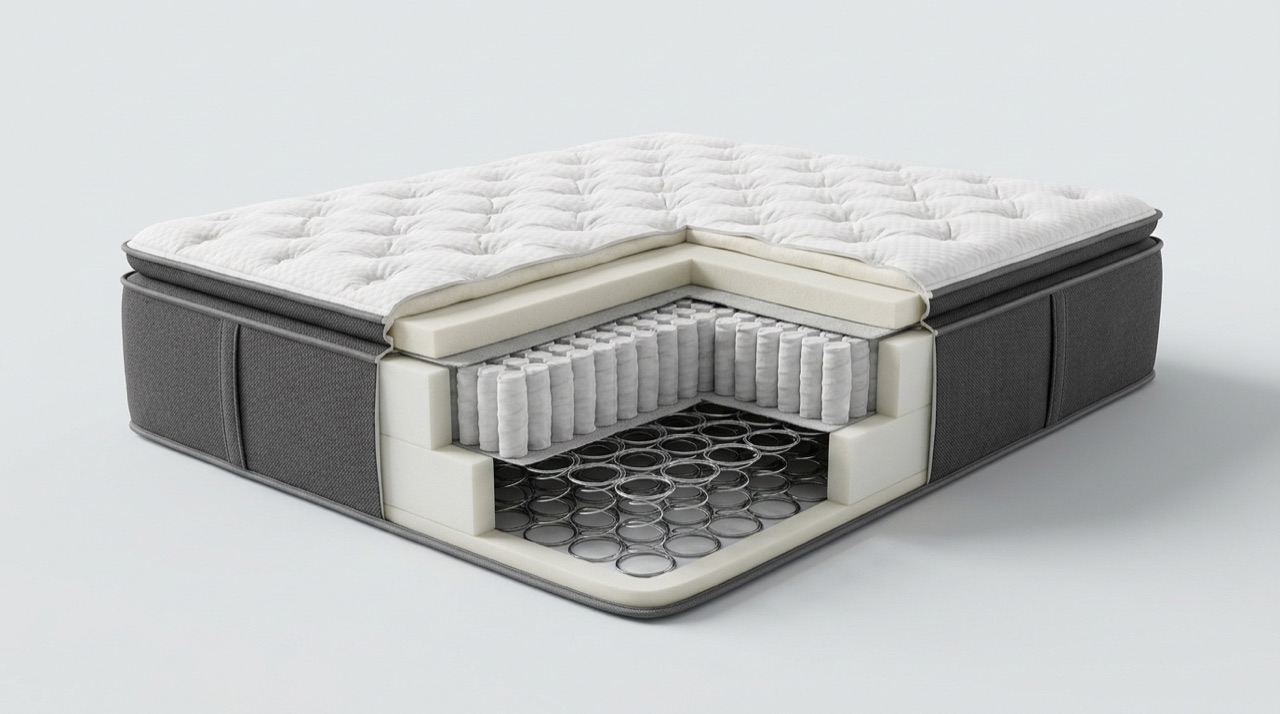
In testing, center-third zoning turned out to be the single biggest differentiator for lower back pain:
- Dual-Coil Innersprings (Saatva Classic): Uses an upper tier of responsive micro-coils over tempered steel hourglass support springs, reinforced right across the center third with a Lumbar Zone® active wire and high-density memory foam strip. Back sleepers feel immediate, spring-assisted lift under the small of the back without stiff board-like pressure under the tailbone.
- Tri-Zone Pocketed Coils (Nolah Evolution 15): Combines thick perforated AirFoam™ HD pressure relief with stiffer coils concentrated beneath the lumbar region and gentler coils beneath the shoulders.
- Zoned Side-Sleeper Hybrids (Helix Midnight Luxe): Calibrated slightly softer (6.0/10) so side sleepers get deep shoulder give while reinforced center-third coils stop hip drop.
- Uniform All-Foam (Nectar Memory Foam): Works cleanly for lighter-to-average side sleepers under 180 lbs looking for budget pressure relief, though lacks the targeted coil pushback heavier back sleepers often need.
| Mattress Build | Lumbar Lift | Joint Cushioning | Best Matched Body Weight & Position | Tested Lab Example |
|---|---|---|---|---|
| Dual-Coil Hybrid | 9.8 / 10 | 9.5 / 10 | Back & combo sleepers, 130–280+ lbs | Saatva Classic |
| Tri-Zone AirFoam Hybrid | 9.5 / 10 | 9.8 / 10 | Side & back sleepers with hip/lumbar soreness | Nolah Evolution 15 |
| Zoned Comfort Hybrid | 9.4 / 10 | 9.9 / 10 | Side & combo sleepers needing shoulder + hip balance | Helix Midnight Luxe |
| Cashmere Euro-Top Hybrid | 9.5 / 10 | 9.3 / 10 | Back sleepers & heavier frames wanting luxury loft | DreamCloud Premier |
| Gel All-Foam | 8.7 / 10 | 9.8 / 10 | Lighter side sleepers (< 180 lbs) on a budget | Nectar Memory Foam |
Body Weight & Sleeping Position Rules That Change Everything
Firmness ratings only make sense relative to how much downward force your body puts on the foam. Every 50 pounds of body weight shifts how firm a bed feels by roughly one full point:
Lightweight Sleepers (Under 135 lbs)
Light frames barely engage deep support coils beneath a thick pillow top. On a 7.5/10 bed, a 120-lb back sleeper simply sits on top of stiff quilting with minimal contouring. Target 5.0 to 6.0 / 10—for instance, Saatva's Plush Soft or Medium hybrids with at least 2 to 3 inches of responsive top padding.
Average-Weight Sleepers (135–230 lbs)
This range hits the classic 6.0 to 7.0 / 10 window. Back sleepers perform best around 6.5/10, while dedicated side sleepers with morning lumbar tightness usually feel best around 6.0/10 with zoned coils. (For a full posture-by-posture scale breakdown, see our How to Choose Mattress Firmness Guide.)
Heavy Sleepers (Over 230 lbs)
Above 230 lbs, thin 10-inch all-foam mattresses compress past their comfort transition layer straight onto firm base foam—creating premature indentations within a year or two. Look for 13.5 to 15-inch hybrids with thick steel coils (12.5–14.5 gauge) and high-density foam borders like DreamCloud Premier or Saatva Classic in Firm or Luxury Firm.
Five Hidden Habits Sabotaging Your Lower Back
Even the highest-scoring mattress cannot outwork poor bedroom setup. Before blaming a new bed, audit these five common culprits:
- Wide or Flexing Bed Slats: Platform slats spaced farther than 3 inches apart allow heavy coil cores to bulge downward between slats, quietly creating lumbar sag.
- Stomach Sleeping Without Hip Support: Lying face-down on anything softer than a 7.0/10 firm bed twists lumbar facet joints nightly. (Read our Stomach Sleeper Spine Mechanics Guide for quick wedge tricks.)
- Skip-Turning During the Break-In Window: Brand-new quilted tops soften by roughly 10%–15% over the first 21 to 30 nights. Never judge a mattress by night two alone—use the full break-in month of your sleep trial.
- Twisted Top Knee While Side Sleeping: Letting your upper leg drop forward onto the mattress rotates your lower lumbar spine for hours. Sliding a simple pillow between both knees fixes that twist immediately.
- Overlooking Worn Box Springs: Placing a modern 13.5-inch hybrid onto a spongy, 12-year-old coil box spring transfers every old dip straight upward into your mattress.
Quick 30-Second Alignment Test Tonight
Lie in your normal sleeping posture for five minutes and ask someone to snap a straight eye-level photo of your back from the foot or side of the bed:
- Back sleepers: Slide one flat hand under the small of your lower back. You should feel light, even contact between mattress and skin—neither an open tunnel you can wave your hand through nor crushing pressure against your tailbone.
- Side sleepers: Look at the line tracing from the base of your neck down between your shoulder blades to your tailbone. It should run straight and horizontal across the frame—never dipping down under your waist or sloping uphill toward your hips.
Frequently Asked Questions
Is a topper enough to fix lower back pain on an old mattress?
Only if your bed is too firm while the support core underneath is still flat and solid. If your mattress already sags more than three-quarters of an inch in the middle, a soft topper just molds right down into the existing valley and worsens spinal crookedness.
Are all-foam mattresses bad for lower back pain?
No—high-density memory foam works well for lighter side sleepers and some combo sleepers. However, in head-to-head testing (Memory Foam vs. Hybrid Comparison), zoned coil hybrids consistently hold heavier hips higher and deliver easier overnight mobility when changing positions.
How long does it take for morning back stiffness to improve on a new mattress?
Most lab testers report noticing relief within 7 to 14 nights, once tight lumbar guard muscles stop bracing against an old worn spot—though full comfort-layer break-in normally takes 3 to 4 weeks.
Ready to narrow down tested models built for spinal health? Explore our ranked Best Mattresses for Back Pain, compare Saatva vs. Helix, check live promo codes on Mattress Deals & Coupons, or take our 60-second Sleep Match Quiz.

Jessica Moore, Certified Sleep Science Coach
Jessica has spent 8+ years analyzing biomechanics, pressure relief mapping, and mattress ergonomics. She leads our independent sleep lab in Austin, TX, overseeing thermal, motion, and durability testing.