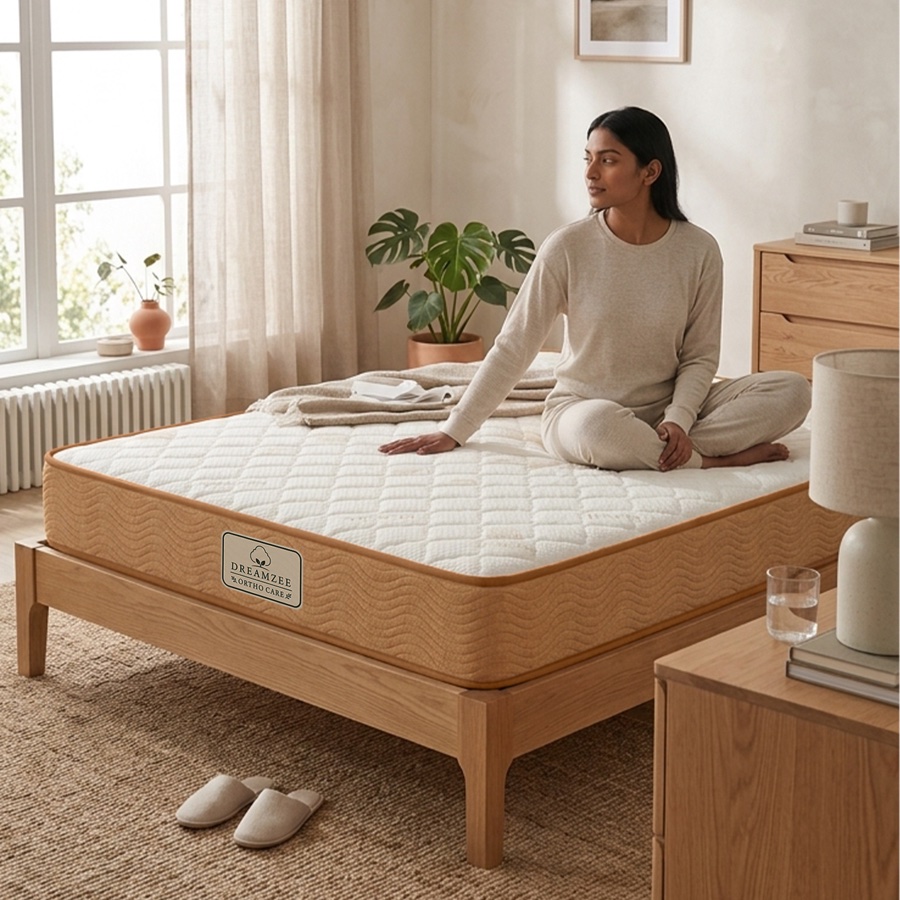
Nectar wins on pressure relief and motion isolation, while Leesa offers better bounce for combination sleepers.
Nectar Memory Foam
12" Gel Memory Foam, Starts at $349
- Near-perfect motion isolation (9.9/10) absorbs partner movement
- Exceptional pressure relief (9.8/10) for chronic hip and shoulder pain
- Substantially lower entry price point across all standard sizes
Leesa Original
10" All-Foam, Starts at $719
- Faster foam response time allows effortless nocturnal position shifts
- Slightly softer medium feel (5.5/10) accommodates strict side sleepers
- Balanced foam construction avoids the feeling of being 'stuck' in bed
Key Takeaways
- Nectar Memory Foam offers deeper contouring and a true memory foam hug, while the Leesa Original delivers a more responsive, buoyant all-foam feel.
- Nectar edges out Leesa in motion isolation (9.9/10 vs. 9.4/10), making it a superior choice for light sleepers sharing a bed.
- Leesa responds faster to position adjustments due to its proprietary polyfoam comfort layer, making combination sleeping easier.
- Both brands provide an industry-leading 365-night home trial and lifetime warranty coverage, but Nectar starts at a significantly lower entry price ($349 vs. $719).
| Metric / Specification | Nectar Memory Foam | Leesa Original |
|---|---|---|
| Mattress Construction | Gel Memory Foam (3 layers) | Responsive Polyfoam + Memory Foam (3 layers) |
| Profile Height | 12 inches | 10 inches |
| Lab Firmness Rating | 6.0 / 10 (Medium-Firm) | 5.5 / 10 (Medium) |
| Pressure Relief Score | 9.8 / 10 | 9.3 / 10 |
| Motion Transfer Score | 9.9 / 10 | 9.4 / 10 |
| Thermal Dissipation / Cooling | 8.9 / 10 | 8.7 / 10 |
| Edge Support Rating | 8.8 / 10 | 8.4 / 10 |
| Trial Period & Warranty | 365 nights / Forever | 365 nights / Lifetime |
| Starting Price (MSRP) | $349 | $719 |
The direct-to-consumer mattress space was largely built on all-foam beds delivered to your doorstep in cardboard boxes. Two of the most recognized models from this era are the Nectar Memory Foam and the Leesa Original. While both mattresses use a three-layer foam stack wrapped in a breathable knit cover, their on-body tactile performance could hardly be more different.
Deciding between them comes down to whether you want the slow-melting hug of traditional visco-elastic foam or a springier, more buoyant all-foam surface. If you are exploring the broader market, you have likely looked at matchups like Nectar vs Casper or Saatva vs Leesa. In this review, we examine the raw mechanical metrics from our sleep lab to see whether Nectar or Leesa deserves a spot in your bedroom, and how their foam densities perform under real anatomical loads.
Construction and Material Teardown
The Nectar Memory Foam measures 12 inches in height. Beneath its polyethylene-blend cooling cover rests a 2-inch layer of gel-infused memory foam, followed by a 3-inch dynamic response transition foam, and a 7-inch high-density polyfoam support base. The gel infusion in the upper layer is designed to pull heat away from the body, but its primary mechanical function is pressure mitigation. The dynamic foam beneath keeps heavier areas like the hips from sinking unchecked into the base. For those who want more lift, Nectar also produces hybrid variants like the Nectar Classic Hybrid and the premium Nectar Luxe Hybrid.
The Leesa Original stands at a sleeker 10-inch profile. Its upper comfort layer is a 2-inch proprietary breathable polyfoam with a latex-like bounce, followed by a 2-inch memory foam recovery layer, and a 6-inch high-density base core. By positioning responsive polyfoam above the memory foam, Leesa avoids the sluggish surface feel that characterizes classic memory foam mattresses. You still get contouring support from the middle layer, but you sit slightly more "on top" of the mattress rather than sinking deeply into it.
Firmness, Feel, and Response Time
On our 10-point firmness scale (where 1 is cloud-soft and 10 is porcelain-hard), our testing team clocked the Nectar at a 6.0 out of 10, categorizing it as a true medium-firm. The Leesa Original rated slightly softer at 5.5 out of 10, giving it a true medium feel.
When you press your hand into the Nectar, the material yields gradually. It takes roughly 2.8 seconds for the top layer to fully recover its original shape after removing dynamic pressure. This slower hysteresis loop explains why back sleepers needing steady lumbar contouring rank it among the contenders for the best mattress for back pain.
In contrast, the Leesa snaps back within 0.7 seconds. That rapid rebound eliminates the feeling of being trapped in a contour rut, making it significantly easier to rotate from side to back during the night. If you switch positions frequently, Leesa's bounce gives it an edge, whereas Nectar excels at cradling persistent pressure zones.

Lab Pressure Relief Mapping
To measure pressure relief, we placed ultra-thin sensor mats across both mattresses and tested human subjects of varied weights: light (under 130 lbs), average (130–230 lbs), and heavy (over 230 lbs).
Nectar recorded exceptional results for side and back sleepers, earning an overall 9.8/10 pressure relief score. The 2 inches of visco foam redistribute peak forces across the lateral trochanter (hip bone) and acromion process (shoulder). Even our broad-shouldered testers experienced virtually zero localized pressure buildup (shown as blue and green on our pressure mapping software, with zero red spikes).
Leesa scored a solid 9.3/10. For average-weight side sleepers, the top polyfoam layer compresses gently before easing into the secondary memory foam layer. However, our testers over 220 pounds noted some minor pressure accumulation near the hip socket as they pushed through the top 4 inches of comfort foam and engaged the dense 6-inch base. For heavier individuals who require heavy-duty lumbar stability, we often recommend reviewing the best mattress for heavy people or exploring reinforced innerspring builds like the WinkBeds Plus.
Motion Transfer and Couple Dynamics
If you sleep with an active partner or a pet, motion isolation is critical. In this metric, Nectar dominated our testing with an elite 9.9/10 rating. During our accelerometer drop tests—where a 15-pound bowling ball is dropped from a height of 12 inches onto one side of the bed—our sensors on the opposite side registered negligible kinetic displacement. The slow-reacting memory foam deadens vibrational energy almost instantly, earning Nectar regular placement among our best mattress for couples selections.
Leesa scored 9.4/10 in motion isolation. While very competent—and vastly superior to traditional innersprings—its buoyant top layer does transmit a fraction more surface ripple than Nectar. If you are an exceptionally light sleeper whose partner tosses and turns, Nectar provides a noticeably quieter, more isolated surface.
Edge Support and Temperature Regulation
All-foam mattresses are historically prone to perimeter sagging. When sitting on the perimeter of the 12-inch Nectar, our lab equipment measured 3.4 inches of vertical compression, resulting in an 8.8/10 edge support score. The denser, taller base core helps keep you stable when tying shoes or sleeping near the edge.
The 10-inch Leesa compressed 4.1 inches under the same load, earning an 8.4/10. While completely safe for sleeping without feeling like you will roll off, sitting on the perimeter feels slightly less supportive due to its lower profile and softer top foam.
For cooling, all-foam designs store more ambient body heat than open-coil hybrids like the Helix Midnight Luxe. However, both beds managed temperature reasonably well in our lab. Nectar's gel-infused layer and breathable exterior scored an 8.9/10, keeping surface temperatures around 88.5°F after 30 minutes of continuous body contact. Leesa followed closely at 8.7/10 (surface temp 89.1°F), relying on the open-cell structure of its proprietary top foam to encourage airflow.
Pricing, Trial Periods, and Practical Buying Advice
When comparing baseline economics, Nectar has a decisive price advantage. Starting at $349 for a twin ($659 for a queen typically during sales), it is one of the strongest value propositions in the best mattress in a box segment. Leesa begins around $719 for a twin and climbs above $1,000 for a queen.
Both companies offer generous consumer protections: an industry-leading 365-night sleep trial and a lifetime warranty. Before ordering, we always suggest reading our guide on understanding mattress sleep trials and return fees to make sure you allow adequate time for foam adaptation, as well as our review of how long a mattress in a box takes to expand.
If you are comparing other alternatives within this category, take a look at our Nectar vs DreamCloud and Nectar vs Puffy breakdowns, or see our high-end luxury comparisons like Leesa vs Tempur-Pedic.
The Final Verdict
Choose the Nectar Memory Foam if:
- You want deep, body-hugging contouring and superior joint pressure relief.
- You share your bed with a restless partner and need maximum motion isolation.
- You want premium foam performance while keeping your budget well under $800 for a queen.
Choose the Leesa Original if:
- You dislike the feeling of being trapped in memory foam and prefer quick-rebounding pushback.
- You are a combination sleeper who changes positions repeatedly throughout the night.
- You prefer a slightly softer, medium feel (5.5/10) that cushions the shoulders quickly.
Frequently Asked Questions
Which mattress is better for side sleepers?
Both beds serve side sleepers well, but light-to-average side sleepers often favor the Nectar Memory Foam because its visco-elastic layer allows deeper sinkage at the hip and shoulder joints, keeping spinal alignment neutral.
Do either of these mattresses require a box spring?
No. Both Nectar and Leesa perform best on a firm, flat, non-spring surface such as a slatted platform bed (with slats no more than 3 to 4 inches apart), an adjustable base, or a solid bunkie board. Using an unsupportive foundation may void your protection; consult our breakdown on how to read a mattress warranty for specific structural requirements.
How do they compare in terms of longevity and sagging?
Both brands use high-density polyfoam base layers capable of maintaining structural integrity for 7 to 10 years with proper care. To prevent localized depressions, follow our guide on should you flip or rotate your mattress, turning your mattress head-to-foot every 3 to 6 months.

Jessica Moore, Certified Sleep Science Coach
Jessica has spent 8+ years analyzing biomechanics, pressure relief mapping, and mattress ergonomics. She leads our independent sleep lab in Austin, TX, overseeing thermal, motion, and durability testing.