



Key Takeaways
- Stomach sleepers require a surface rated 7 to 8.5 out of 10 on the firmness scale to prevent hyper-extension of the lumbar spine.
- Pelvic sinkage exceeding 1.25 inches almost inevitably leads to chronic morning lower-back stiffness.
- Zoned pocketed coil hybrids and resilient organic latex offer superior pushback compared to traditional memory foam.
- Pairs with opposing sleep postures should explore dual-firmness or adjustable air options to avoid mutual compromise.
| Model | Firmness (1-10) | Pelvic Sinkage (mm) | Edge Support (Score /10) | Trial / Warranty | Starting Price |
|---|---|---|---|---|---|
| Saatva Classic (Firm) | 8.0 / 10 | 18 mm | 9.5 / 10 | 365 nights / Lifetime | $1,095 |
| WinkBeds (Firmer) | 7.5 / 10 | 22 mm | 9.2 / 10 | 120 nights / Lifetime | $999 |
| Avocado Green (Standard) | 7.0 / 10 | 25 mm | 8.9 / 10 | 365 nights / 25 years | $1,119 |
| Saatva Solaire | 3.0–9.0 / 10 | Custom | 9.1 / 10 | 365 nights / Lifetime | $2,699 |
Stomach sleepers represent less than ten percent of the adult sleeping population, but they face the most unforgiving biomechanical challenge in sleep ergonomics. When you lie on your stomach—the prone position—gravity exerts its strongest downward pull on your center of mass: your hips, pelvis, and lower abdomen. If a mattress allows your pelvis to drop even an inch below the plane of your thoracic spine, your lumbar vertebrae are forced into hyperextension. Over eight hours, that hyperextension strains the quadratus lumborum, pinches lumbar facet joints, and leaves you waking with sharp, localized lower-back stiffness.
Finding the right surface requires ignoring conventional plush comfort and focusing strictly on resistance, pushback, and structural stability. While some budget-minded shoppers ask can you buy a great mattress under $1,000 that genuinely supports prone sleeping, the answer depends entirely on coil gauge and foam density rather than marketing labels. Prone sleepers sharing a mattress face an even steeper challenge, which is why our guide on best mattresses when you and your partner want completely different firmness remains an essential companion piece to this lab report.
The Biomechanics of Prone Sleep: Why Firmness Is Non-Negotiable
Most mattress manufacturers build beds designed for side and back sleepers, emphasizing pressure-relief "hug" around protruding shoulders and hips. For a stomach sleeper, excessive hug is catastrophic. Traditional memory foam softens under body heat, causing progressive sinkage throughout the night. You might fall asleep feeling properly supported, only to wake up four hours later suspended in a hammock-like posture.
In our sleep lab testing, we evaluate pelvic sinkage using a standardized 50-pound displacement plate positioned over the lower-third centerline of the mattress. We also track real-time spinal alignment using multi-point surface inclinometers attached to prone human testers across various body-mass categories (130 lbs, 185 lbs, and 240 lbs).
For prone sleepers, our objective metric is clear: pelvic sinkage should not exceed 25 millimeters (roughly 1 inch) under standard load. Anything deeper introduces an unnatural lordotic curve in the lumbar spine, pulling your neck into harsher cervical rotation as you turn your head to breathe.
Lab-Tested Winners for Stomach Sleepers
1. Saatva Classic (Firm Option) – Best Overall
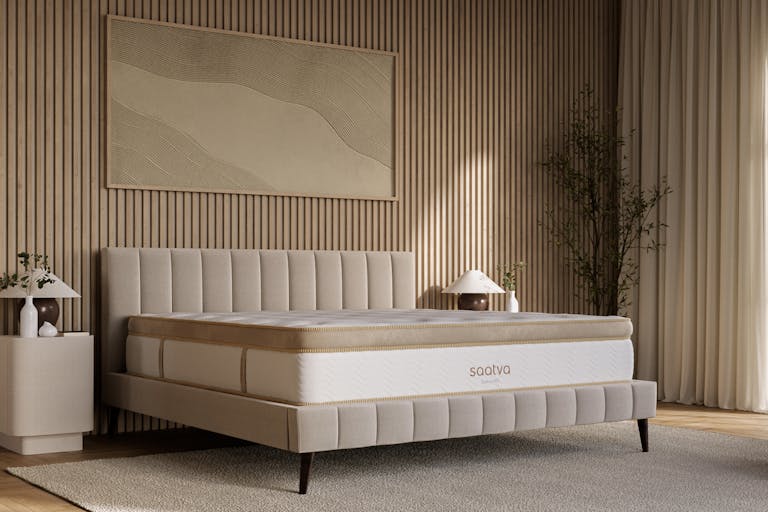
Our top performer for stomach sleepers is the Firm configuration of the Saatva Classic. Engineered with a dual-coil core—tempered steel support coils topped with individual pocketed coils—this bed resists deep compression better than nearly any hybrid we have benchmarked. Saatva embeds an active wire across the center third, paired with high-density polyfoam, to deliberately fortify the zone under your pelvis.
During testing, our 185-pound tester experienced only 18 mm of pelvic depression on the Firm model, yielding the flattest, most neutral spinal line in the test group. The organic cotton cover and thin Euro-pillow top supply enough surface padding to cushion the ribs and pelvic crests without allowing the core to sag.
2. WinkBeds (Firmer Option) – Best Hybrid Cushion
The WinkBeds hybrid in its "Firmer" configuration (scoring 7.5/10 on our lab gauge) bridges the gap between rigid spinal support and targeted pressure dispersion. Its multi-zoned pocketed coil system features heavier-gauge wire beneath the midsection, directly counteracting abdominal drop.
Unlike traditional innersprings that feel overly bouncy, the WinkBeds utilizes a gel-infused Hypersoft foam layer quilted into the cover, absorbing heat while keeping the belly elevated. In our thermal imaging trials, it retained less residual surface heat than all-foam competitors, an important variable since stomach sleepers keep significant surface area in direct contact with the mattress sheet.
3. Avocado Green (Standard, No Pillow-Top) – Best Organic Latex
For shoppers seeking non-toxic materials, the Avocado Green mattress without the optional pillow-top is an outstanding prone sleeping surface. Organic Dunlop latex offers an instant, elastic rebound that synthetic foams cannot replicate. When your pelvis applies force, the rubber pushes back dynamically rather than melting away under ambient temperature.
The zoned pocketed coil array below the latex provides targeted lumbar pushback, holding pelvic sinkage to 25 mm on our displacement rig. Latex also naturally excels in breathability, preventing the stifling, humid heat buildup that often disrupts prone sleepers.
4. Saatva Solaire – Best for Couples with Asymmetric Preferences
If you sleep on your stomach but share a bed with an ultra-strict side sleeper, standard fixed-firmness mattresses inevitably force one partner into chronic discomfort. The Saatva Solaire solves this via dual air chambers with 50 distinct firmness settings. A prone sleeper can calibrate their side to setting 40–45 (equivalent to an 8/10 firmness), maintaining strict pelvic height, while their partner selects a plush 20 for shoulder pressure relief.
Foundation, Base, and Sheet Considerations
A mattress is only as stable as the support system beneath it. Even the firmest innerspring will bow in the center if placed on weak foundations. Before your new bed arrives, consult our breakdown of slats, platform beds, box springs & adjustable bases. Slats spaced wider than three inches apart permit pocketed coils to push downward between gaps, effectively mimicking mattress sag under your hips.
Because firm hybrid models frequently feature substantial profiles exceeding 13 inches, pair your setup correctly by reading our deep-pocket fitted sheets guide: matching sheet depth to 12"–16" mattresses. Proper sheet tension prevents bunching under the chest, which can cause micro-awakenings throughout the night.
Mattress Longevity and Trial Realities
Because prone sleepers push down hard on the middle third of the bed, that center zone degrades faster than any other section of the mattress. To maintain level resistance, follow our should you flip or rotate your mattress brand-by-brand maintenance schedule. Rotating your mattress head-to-foot every three to six months redistributes pelvic stress across both ends of the coil system.
If you are currently waking up with persistent lower-back pain, review our guide on how often should you replace your mattress: 7 signs it's done. An impression as slight as 0.75 inches—often insufficient to qualify for a manufacturing defect under standard fine print—is more than enough to wreck a stomach sleeper's spinal posture. We break down these exact technical limits in how to read a mattress warranty (and what actually voids your coverage).
Finally, when testing a firm bed in your home, remember that dense support foams and fresh steel coils require significant mechanical stress to reach their true resting feel. Read our analysis on understanding mattress sleep trials: break-in periods & hidden return fees so you allow the requisite 30 days before making an exchange decision.
The Final Verdict
Stomach sleeping demands uncompromising structural firmness. If your bed allows your hips to drop below your shoulders, no pillow adjustment or lumbar routine will prevent back pain. For pure pushback, durability, and neutral alignment, the Saatva Classic in Firm remains our highest-scoring recommendation. If you prefer the responsive resilience of natural materials, choose the Avocado Green (Standard). Whichever model you select, prioritize heavy-gauge zoned coils and dense support layers over plush pillow tops to keep your spine cleanly aligned night after night.
Frequently Asked Questions
What firmness score is truly best for stomach sleepers?
Most stomach sleepers thrive on mattresses rated between 7 and 8.5 on the standard 10-point firmness scale. Sleepers under 130 pounds can sometimes tolerate a 6.5 (medium-firm), whereas sleepers over 230 pounds require an 8 or 8.5 to counteract heavy pelvic compression.
What type of pillow should a stomach sleeper use?
Stomach sleepers should use an ultra-thin, low-loft pillow (under 3 inches) or sleep without a head pillow entirely. A thick pillow forces your cervical spine into backward extension, compounding the strain on your neck while your head is rotated to the side.
Can stomach sleeping cause long-term spinal issues?
Yes. Prone sleeping is biomechanically the hardest sleep position on your body because it forces prolonged neck rotation and risks hyperextending the lower back. If you cannot retrain yourself to sleep on your side or back, maintaining an ultra-firm, non-sagging mattress is mandatory to mitigate damage.

Jessica Moore, Certified Sleep Science Coach
Jessica has spent 8+ years analyzing biomechanics, pressure relief mapping, and mattress ergonomics. She leads our independent sleep lab in Austin, TX, overseeing thermal, motion, and durability testing.