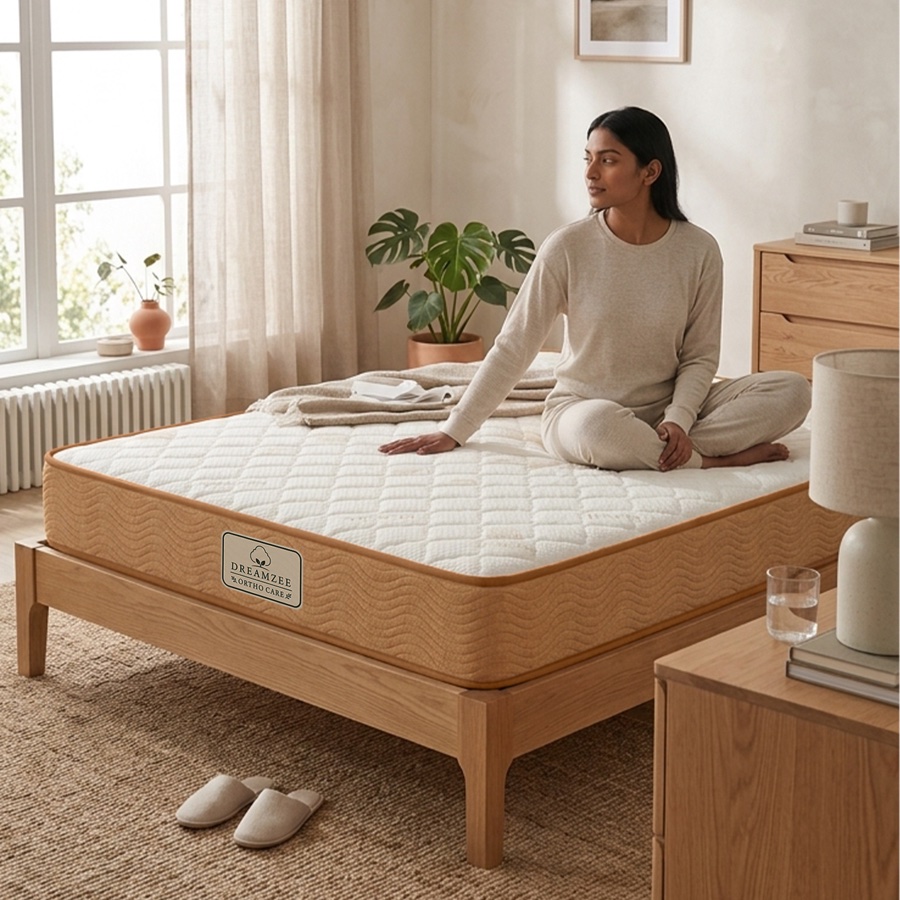
WinkBed earns our top recommendation for structural craftsmanship and lumbar zoning, while DreamCloud leads on pure price-to-performance value.
WinkBed
13.5" Zoned Innerspring Hybrid | $999+
- Exceptional edge support rating (9.8/10) with heavy-gauge perimeter coils
- Dedicated LumbarLayer and multi-zoned pocketed coils prevent spinal sag
- Available in four distinct firmness variations for custom body-type matching
DreamCloud
12" Cashmere-Blend Hybrid | $499+
- Unbeatable price point for an upscale pillow-top hybrid construction
- Thicker gel memory foam delivers superior vibration dampening for couples
- Generous 365-night trial period and non-prorated lifetime warranty
Key Takeaways
- WinkBed dominates edge support (0.8-inch perimeter sinkage vs. DreamCloud's 1.6-inch) and features zoned lumbar support coils.
- DreamCloud provides superior motion isolation thanks to its thicker layer of gel memory foam beneath a quilted cashmere-blend top.
- WinkBed offers four firmness feels (Softer, Luxury Firm, Firmer, Plus), whereas DreamCloud sells in a single medium-firm baseline.
- DreamCloud holds a clear pricing advantage, starting hundreds lower than WinkBed while still offering a 365-night home trial.
| Evaluation Metric | DreamCloud | WinkBed (Luxury Firm) |
|---|---|---|
| Mattress Profile | 12 inches | 13.5 inches |
| Firmness Feel (1–10 Scale) | 6.5 / 10 (Luxury Firm) | 6.5 / 10 (Also available in 4.5, 7.5, 8.0) |
| Edge Support Deflection | 1.6 inches (Lab Score: 8.9/10) | 0.8 inches (Lab Score: 9.8/10) |
| Motion Transfer Reduction | 9.1 / 10 (Lab Tested) | 8.9 / 10 (Lab Tested) |
| Core Support System | 8.5" Individually Wrapped Coils | Triple-Zoned Coils + Extra-Firm Perimeter |
| Trial & Warranty | 365 Nights / Lifetime Warranty | 365 Nights / Lifetime Warranty |
| Starting Price | $499 | $999 |
If you are shopping for a luxury hybrid mattress that blends the pressure relief of contouring foams with the responsive lift of steel pocketed coils, you have inevitably narrowed your shortlist to two major contenders: the DreamCloud and the WinkBeds flagship innerspring. Both models market themselves as affordable hotel-caliber centerpieces, featuring tufted pillow tops, reinforced coils, and long-term warranties that blow typical retail store policies out of the water.
Yet under the hood, these beds possess noticeably different structural philosophies. Where DreamCloud targets an all-around crowd with a plush-on-top, contouring memory foam sandwich, WinkBed delivers a traditionally engineered, zone-supported innerspring that behaves closer to high-end hospital-grade ergonomic beds. While we routinely pit these models against luxury giants in matchups like Saatva vs DreamCloud and Saatva vs WinkBeds, matching DreamCloud and WinkBed directly against each other exposes crucial distinctions in motion absorption, edge rigidity, and spinal alignment—distinctions that dictate which bed will actually solve your chronic back aches, as highlighted in our guide to the Best Mattress for Back Pain.
Construction and Materials Comparison
Stripping off the external ticking reveals two entirely different design philosophies. The standard DreamCloud stands 12 inches tall. Its build starts with a soft cover knit from a cashmere-polyester blend, quilted directly with high-loft foam to establish an inviting initial sink. Below this surface sits a 1-inch transition layer of gel-infused memory foam engineered for joint cushioning, followed by a dynamically responding transition polyfoam. Structural support is supplied by 8.5 inches of individually wrapped pocketed coils sitting upon a high-density polyfoam foundational slab.
WinkBed elevates the profile to 13.5 inches, beginning with a eucalyptus-derived Tencel cover known for natural breathability. Inside the tufted Euro-pillow top, WinkBed pairs gel-infused hypersoft foam with their proprietary LumbarLayer—a targeted segment of high-density foam situated squarely underneath the small of the back. Its core features a triple-zoned pocketed coil assembly where heavier-gauge steel undergirds the hips, supplemented by an ultra-dense, 4.5-inch border coil perimeter called the Extra-Firm Edge system. Because of its generous profile height, WinkBed shoppers often consult our Deep-Pocket Fitted Sheets Guide: Matching Sheet Depth to 12"–16" Mattresses to ensure bedding stays securely anchored.
Both arrive compressed inside protective cardboard packaging. If you are comparing box unboxing experiences, our lab walkthrough on How Long Does a Mattress in a Box Take to Expand? (Plus Off-Gassing Tips) shows that WinkBed’s heavier pocketed springs expand to full operational firmness within roughly 12 to 24 hours, whereas DreamCloud’s viscoelastic layers typically require a full 36 hours to air out standard factory scents completely.

Laboratory Benchmarks: Testing Head-to-Head
Edge Support
Edge support is where the two models diverge sharply. During our edge-compression testing, we drop a 200-pound load cell along the side perimeter to evaluate perimeter structural deflection.
- WinkBed (9.8/10): Deflected only 0.8 inches. WinkBed incorporates some of the most rigid exterior coil bands on the modern market. You can sit directly on the corner to tie your shoes or sleep inches from the boundary without feeling roll-off anxiety.
- DreamCloud (8.9/10): Recorded 1.6 inches of perimeter drop. DreamCloud relies on standard perimeter spring tension without dedicated outer bands, creating an adequate, but clearly softer, edge under localized weight.
Motion Isolation
To measure vibration damping, we release a 10-pound medicine ball from three feet above the surface and calculate residual shockwave resonance across adjacent zones with tri-axis accelerometers.
- DreamCloud (9.1/10): The gel memory foam layers near the sleep surface act as efficient mechanical dampers. Energy dissipates almost immediately within the top three inches, making it a stellar option for light sleepers sharing a bed, echoing findings from our Nectar vs DreamCloud testing.
- WinkBed (8.9/10): The Euro-pillow top deadens moderate tossing and turning, but the high-tension steel coil system retains a slight, springy cadence that sensitive partners will notice during abrupt bed exits.
Temperature Regulation
Both mattresses scored 9.3/10 during thermal dissipation imaging. The open interior cavity of pocketed coils in both platforms allows rapid evacuation of trapped body heat. However, WinkBed’s Tencel cover holds a slight real-world advantage in sweat management over DreamCloud’s quilted polyester-cashmere blend, which retains marginally more surface moisture in humid bedrooms.
Firmness, Spinal Ergonomics, and Sleeping Position
DreamCloud sells in a single "Luxury Firm" comfort rating that hovers around a true 6.5 out of 10 on the standard firmness index. This balance accommodates average-weight back and side sleepers nicely, cushioning the shoulders while checking hip sinkage. However, if you crave a plusher, more cloud-like embrace, you might look toward the DreamCloud Premier (evaluated in our detailed DreamCloud vs DreamCloud Premier breakdown), which includes extra memory foam cushioning.
WinkBed's decisive advantage rests in personal customizability. Instead of a one-size-fits-all approach, WinkBed manufactures four specialized firmness iterations:
- Softer (4.5/10): Ideal for lightweight side sleepers under 130 pounds who require deep contouring at the hips and shoulder joints.
- Luxury Firm (6.5/10): The flagship sweet spot for multi-position sleepers, back sleepers, and couples.
- Firmer (7.5/10): Designed for committed stomach sleepers who must keep their pelvis lifted above the bed plane.
- Plus (8.0/10): Explicitly engineered with high-density anti-sag foams and zoned latex for individuals over 250 pounds. We evaluate this build thoroughly in our WinkBeds Plus lab review and our Saatva HD vs WinkBed Plus breakdown.
Shoppers seeking fully organic or natural latex hybrids rather than traditional synthetic polyfoams will also appreciate WinkBed’s alternative, the WinkBeds Eco Cloud, which incorporates Talalay latex rather than conventional memory foam.
The Final Verdict: Which Hybrid Should You Buy?
Choose the WinkBed if:
- You want customizable firmness ranging from plush-soft to plus-size reinforcement.
- You suffer from localized lower-lumbar pain and need the focused pushback of zoned innersprings.
- Maximum perimeter stability matters for sitting, getting out of bed, or using every square inch of sleep space.
Choose the DreamCloud if:
- You want an upscale, hotel-style pillow-top aesthetic while keeping your investment strictly under $700–$800 for a Queen.
- You prioritize motion isolation and foam-cushioned pressure relief over firm coil springiness.
- You want an uncomplicated, universally appealing medium-firm feel backed by an industry-leading 365-night sleep trial.
Frequently Asked Questions
Does DreamCloud or WinkBed sleep cooler?
Both mattresses circulate air exceptionally well because their bases consist of breathable pocketed coils rather than solid foam blocks. However, the WinkBed holds a slight edge due to its Tencel cover, which breathes more readily and wicks moisture faster than DreamCloud's cashmere-blend top.
Which mattress is better for side sleepers?
For side sleepers weighing under 130 pounds, the WinkBed Softer is noticeably superior because it prevents painful pressure spots along the humerus and greater trochanter. For average-weight side sleepers (130 to 230 pounds), both the DreamCloud and the WinkBed Luxury Firm provide sufficient hip-and-shoulder sink, though DreamCloud delivers a touch more pressure-relieving foam cradling.
Do WinkBed and DreamCloud require a box spring?
Neither mattress requires a traditional box spring. Both hybrids function properly on any flat, rigid foundation, including solid platform frames, slatted bases with gaps no wider than 4 inches, or heavy-duty adjustable bases. Using an improper base with wide slat gaps will void your structural warranty coverage on both models.

Jessica Moore, Certified Sleep Science Coach
Jessica has spent 8+ years analyzing biomechanics, pressure relief mapping, and mattress ergonomics. She leads our independent sleep lab in Austin, TX, overseeing thermal, motion, and durability testing.