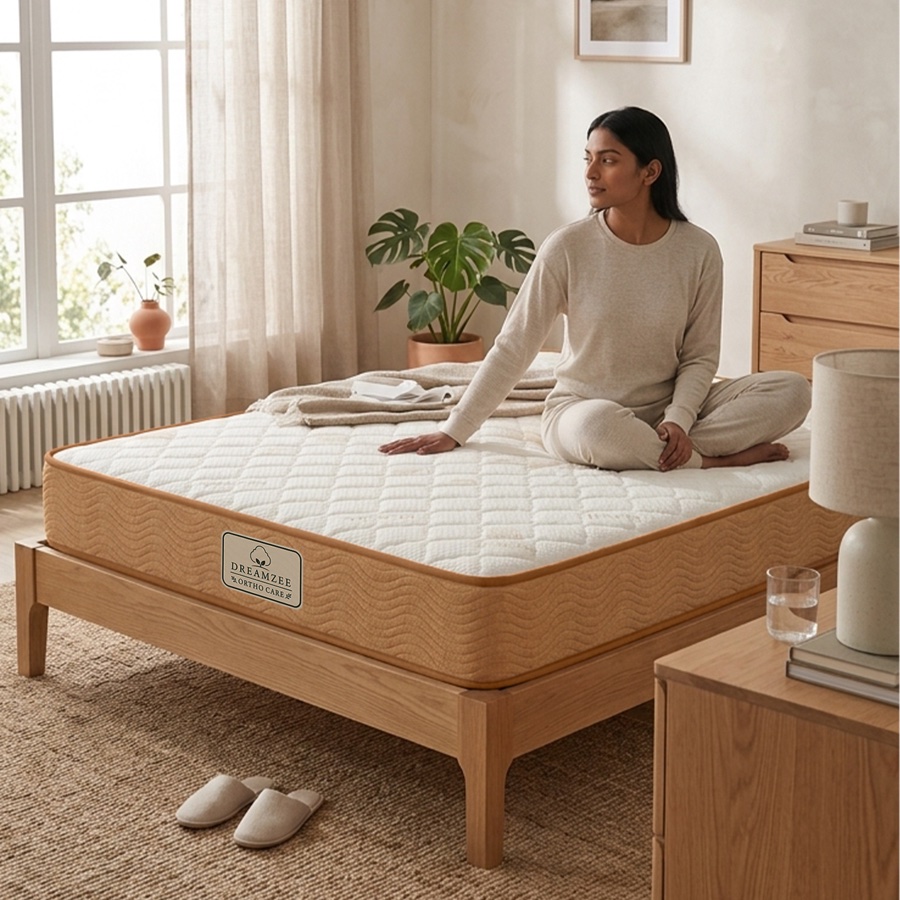
Purple wins for thermal regulation and active support, while Layla takes the edge for budget-conscious side sleepers needing deep contouring.
Purple Mattress
Hyper-Elastic Gel Grid | From $799
- Near-zero heat retention via open-air polymer channels
- Responsive, buoyant feel without sinkhole entrapment
- Balanced medium-firm alignment across multiple sleep postures
Layla Memory Foam
Flippable Copper-Foam | From $599
- Two firmness options (4.5/10 soft and 7.5/10 firm) in one bed
- Superior motion deadening for restless partners
- Deeper pressure relief at the shoulders and hips for strict side sleepers
Key Takeaways
- Purple's 2-inch GelFlex Grid runs 4.2°F cooler than Layla, making it the clear choice for chronically hot sleepers.
- Layla offers dual-sided versatility (Medium-Soft 4.5/10 and Firm 7.5/10) in a single flippable mattress.
- Side sleepers under 130 lbs get superior hip pressure relief on Layla's soft side (sub-24 mmHg).
- Purple offers a more responsive, floating sensation, whereas Layla delivers classic memory foam contouring with exceptional motion deadening.
| Metric / Specification | Purple Mattress | Layla Mattress |
|---|---|---|
| Construction Type | Hyper-Elastic Gel Grid + Polyfoam | Dual-Sided Flippable All-Foam |
| Profile Height | 9.25 inches | 10.5 inches |
| Firmness Rating | 6.5 / 10 (Medium-Firm) | 4.5 / 10 (Soft) & 7.5 / 10 (Firm) |
| Cooling Score | 9.5 / 10 | 8.8 / 10 |
| Pressure Relief Score | 9.3 / 10 | 9.5 / 10 (Soft Side) |
| Motion Isolation Score | 9.2 / 10 | 9.6 / 10 |
| Edge Support Score | 8.5 / 10 | 8.2 / 10 |
| Trial Period & Warranty | 100 Nights / 10-Year Warranty | 120 Nights / Lifetime Warranty |
| Starting Price | $799 | $599 |
Choosing between the original Purple and the flippable Layla mattress comes down to a fundamental clash of material physics: hyper-elastic polymer versus copper-infused viscoelastic memory foam. While both brands target shoppers who need pressure relief without overheating, they approach body contouring from opposite engineering philosophies. If you are browsing the best mattress for back pain or weighing alternatives in our Casper vs Layla analysis, understanding how these internal layers respond to weight and body heat will pinpoint which model suits your body type.
In our sleep lab, we ran both beds through our standardized testing protocol, evaluating surface temperature dissipation with FLIR thermal imaging, measuring joint pressure distribution across various sleeper weights with ultra-thin sensor mats, and assessing motion transfer using seismic accelerometers. Here is how Purple and Layla perform when subjected to concrete mechanical testing.
Construction and Feel Differences
The original Purple measures 9.25 inches tall and is constructed around a proprietary 2-inch GelFlex Grid. This grid is molded from a hyper-elastic polymer arranged in a repeating square column format. Beneath the grid sits a dual-layer polyurethane core: a 3.5-inch transition foam layer and a 4-inch high-density polyfoam base. When you lie down on Purple, the surface feel is completely distinct from conventional foam. The polymer walls buckle only under concentrated pressure points—such as the hips and shoulders—while remaining completely flat and rigid beneath wider surface areas like the lumbar spine. It produces a floating sensation with immediate spring-back.
By contrast, Layla stands 10.5 inches tall and uses a flippable, dual-sided all-foam architecture. One side provides a plush, medium-soft surface (calibrated at 4.5 out of 10 on our firmness scale), while the opposite side yields a stout, firm surface (7.5 out of 10). The interior sandwich consists of a 3-inch copper-gel memory foam layer on the soft side, a 2-inch grooved surface air-flow transition foam, a 4-inch high-density support core, and a 1-inch copper-gel memory foam layer on the firm side. Unlike mattresses requiring strict non-flip schedules detailed in our mattress rotation and flipping guide, Layla is specifically engineered to be flipped end-over-end whenever your comfort preferences evolve. It delivers that signature viscoelastic hug, molding slowly around your contours as it warms.
Pressure Relief and Spinal Alignment
To gauge pressure mitigation, we deployed lightweight (130 lbs), average-weight (175 lbs), and heavyweight (240 lbs) testers across back, side, and stomach postures on our XSENSOR pressure mapping pad. Pressure readings under 32 mmHg represent optimal tissue perfusion, while readings exceeding 40 mmHg point to potential numbness or joint distress.
On Layla’s soft side, side sleepers under 190 lbs saw stellar performance. Peak shoulder pressure registered at a modest 22 mmHg, and hip pressure maxed out at 26 mmHg. The 3-inch copper memory foam layer allows the humeral head and greater trochanter to sink deeply enough for the thoracic and lumbar spine to maintain horizontal alignment. However, for stomach sleepers and individuals over 200 lbs, that same soft side permitted excessive pelvic sag, throwing the lumbar spine into lordotic hyperextension. Flipping Layla to its firm side resolved this for back sleepers, keeping hips elevated atop the 4-inch core, though lightweight side sleepers found the firm side too rigid, producing sharp spikes at the outer shoulder.
Purple showed remarkable consistency across varied body sizes due to the dynamic physics of its grid. Rather than softening progressively with ambient temperature like memory foam, Purple’s polymer columns collapse immediately under localized weight thresholds. In our tests, back sleepers experienced near-perfect lumbar cradling, with pressure readings uniformly distributed across the sacrum at 18 to 22 mmHg. Average-weight side sleepers enjoyed excellent relief without the dense sinkhole sensation found on traditional memory foam models like those explored in our Purple vs Tempur-Pedic evaluation. However, side sleepers under 125 lbs sometimes fail to exert sufficient pressure to buckle the polymer walls, leaving them feeling as though they are resting on top of a relatively firm grid. If you prefer a deep, cradling surface, Layla’s soft side is closer to a true soft mattress experience.
Thermal Regulation and Heat Dissipation
Thermal performance is one area where our lab sensors demonstrated an undeniable performance gap. Memory foam has a documented tendency to store body heat within its closed-cell chemical matrix. Layla combats this by infusing its memory foam with conductive copper particles and channeling airflow through grooved transition foam. In our thermal imaging baseline test, a tester rested on Layla for 60 minutes, bringing the surface temperature up to 92.4°F. After the tester exited, Layla required 9 minutes and 40 seconds to return to ambient room temperature (71°F).
Purple, however, is naturally immune to closed-cell heat traps. The GelFlex Grid consists of roughly 80% open air. Thermal imaging recorded a peak surface temperature of just 88.2°F under the same room conditions, and the bed dispersed that heat back to baseline within 2 minutes and 15 seconds. If you are comparing breathable beds or looking at models featured in our Purple vs Puffy breakdown, Purple's raw passive airflow makes it a superior option for night sweats.
Motion Transfer and Edge Support
For co-sleepers, isolating partner movement is critical to unbroken sleep cycles. When assessing performance for our best mattress for couples guide, Layla scored a formidable 9.6 out of 10 in motion deadening. During our 10-pound drop ball test, Layla’s dense copper memory foam absorbed kinetic energy almost instantaneously, recording minimal ripple on our surface seismometer. If your partner tosses and turns frequently, Layla dampens energy transfer slightly better than Purple, performing similarly to the dense foams evaluated in our Nectar vs Layla analysis.
Purple is by no means disruptive—its independent polymer grid walls isolate force locally rather than transmitting it laterally—earning a solid 9.2 out of 10. You will feel a slight localized wobble if a partner shifts abruptly, but it falls well below the disruption threshold of traditional innerspring beds.
Edge support is a shared vulnerability for both all-foam mattresses. Layla’s perimeter compressed 2.85 inches when sitting directly on the edge of the soft side, though the firm side held up better at 2.1 inches of compression. Purple includes high-density foam encasement borders around the GelFlex Grid, recording 2.35 inches of edge sinkage. If maximum perimeter stability is a non-negotiable priority, you may want to examine hybrid builds like the Purple Hybrid, which pairs the polymer grid with reinforced perimeter coils.
Unboxing, Trial Periods, and Value
Both mattresses arrive compressed in cardboard boxes. Following delivery, our lab models required approximately 24 to 36 hours to fully decompress, a timeline consistent with our mattress expansion benchmarks. Layla exhibited a mild off-gassing scent that fully dissipated within 48 hours, while Purple produced a faint rubber-like odor from the polymer grid that cleared after two days in a well-ventilated space.
When it comes to total ownership value, Layla provides significant perks. Starting at $599, it includes a 120-night trial and a lifetime warranty covering indentations greater than 1 inch. Purple starts higher at $799, backed by a 100-night trial and a 10-year warranty. Before purchasing either, review our guide to mattress sleep trials and return fees to make sure you allow the mandatory 30-day break-in window required by most direct-to-consumer return policies.
The Final Verdict: Which Bed Should You Buy?
Choose the Purple Mattress if:
- You sleep warm: The grid's open air matrix provides cooling performance that no standard memory foam can match.
- You want active, responsive support: The polymer grid flexes instantly beneath joints while pushing up against your lower back, avoiding that stuck-in-the-mud feeling.
- You are a combination or back sleeper: The 6.5/10 medium-firm feel provides an optimal balance of spinal alignment and dynamic contouring as you switch positions.
Choose the Layla Mattress if:
- You want firmness versatility: The ability to alternate between a 4.5/10 plush side and a 7.5/10 firm side eliminates the fear of ordering the wrong feel.
- You are a strict side sleeper under 180 lbs: Layla’s soft side produces deeper sinkage at the shoulders, eliminating lateral pressure points better than Purple's grid.
- You are mindful of your budget: Layla delivers two distinct sleeping surfaces, a lifetime warranty, and a lower starting price point.
Frequently Asked Questions
Does the Purple grid break down faster than Layla's memory foam?
No. Purple's hyper-elastic polymer is remarkably resilient against permanent body impressions. In our simulated mechanical roller tests, the GelFlex Grid maintained its structural elasticity without material degradation. Layla's copper-infused foam is also durable, but like all memory foams, the softer side will naturally show minor compression over years of continuous use.
Can I use a regular heating pad on both mattresses?
Avoid high heat on Purple. Excessive heat can alter the physical flexibility of hyper-elastic polymer, potentially voiding your warranty. Layla handles standard heating pads safely, though the added warmth will cause the memory foam directly beneath the pad to soften and contour more deeply than usual.
Which mattress is easier to move around on?
Purple is substantially easier to navigate. Because the GelFlex Grid snaps back into shape immediately when pressure is removed, repositioning requires virtually zero muscle effort. Layla's memory foam exhibits a slight delayed recovery, which can make combination sleepers feel momentarily resisted when rolling over.

Jessica Moore, Certified Sleep Science Coach
Jessica has spent 8+ years analyzing biomechanics, pressure relief mapping, and mattress ergonomics. She leads our independent sleep lab in Austin, TX, overseeing thermal, motion, and durability testing.