Key Takeaways
- A standard Queen offers 30 inches of width per person, which is 8 inches narrower than an individual sleeping alone on a Twin bed.
- A Standard King (76" x 80") prioritizes width, while a California King (72" x 84") trades 4 inches of width for 4 extra inches of length suited for sleepers over 6'2".
- Maintain at least 30 to 36 inches of clear walking space around the perimeter of the bed frame to prevent visual clutter and cramped circulation paths.
- Factor in staircase turns, door jams, and hallway angles; King frames require split box springs or compressed hybrid delivery to clear tight architectural thresholds.
Upgrading your mattress setup often comes down to an uncomfortable physical compromise: maximizing your personal sleep surface without turning your bedroom into an impassable obstacle course. While finding a model from our list of the Best Mattress 2026 options ensures good pressure relief, physical dimensions dictate daily room flow and partner disturbance. Even the most supportive bed fails if you spend every morning stubbing your toes against the bed frame.
Before taking our Sleep Match Quiz or obsessing over material profiles, you need to map out exact floor tape measurements. Mattress dimensions affect everything from micro-arousals caused by partner repositioning to the postural alignment covered in our guide on how to choose mattress firmness for your sleeping position. Whether you are considering a flagship innerspring like the Saatva Classic or a contouring hybrid, spatial layout is the true foundation of sleep ergonomics.
Mattress Dimensions: Exact Surface Area and Width Per Sleeper
Many couples assume a standard Queen provides ample space, only to realize that sharing a 60-inch-wide mattress gives each partner less lateral width than an infant in a crib or a single child on a standard Twin mattress.
Here is how the numbers break down:
* Queen (60" W x 80" L | 4,800 sq in): Allocates exactly 30 inches of width per adult. This works adequately for sound, still sleepers, but leaves zero buffer zone for limb splay or restless tossing.
* King / Eastern King (76" W x 80" L | 6,080 sq in): Allocates 38 inches of width per adult—the exact equivalent of pushing two standard Twin beds together. You gain a full 16 inches of horizontal space over a Queen.
* California King (72" W x 84" L | 6,048 sq in): Reallocates surface area by subtracting 4 inches of horizontal width and adding 4 inches of vertical legroom. Each partner receives 36 inches of width, with total length reaching 7 feet.
If you or your partner wake easily, horizontal space acts as your primary buffer against mechanical disturbance. Couples who transition from a Queen to a King often report an immediate reduction in nighttime awakenings, not because the foam or coil formulation changed, but simply because their partner's physical movements no longer compromise their personal sleep zone.
Minimum Room Size Requirements: The 30-Inch Rule
Interior designers and human factor engineers rely on clearance margins to maintain natural movement through a bedroom. The baseline standard is simple: you need at least 30 to 36 inches of unobstructed clearance on all accessible sides of the bed.
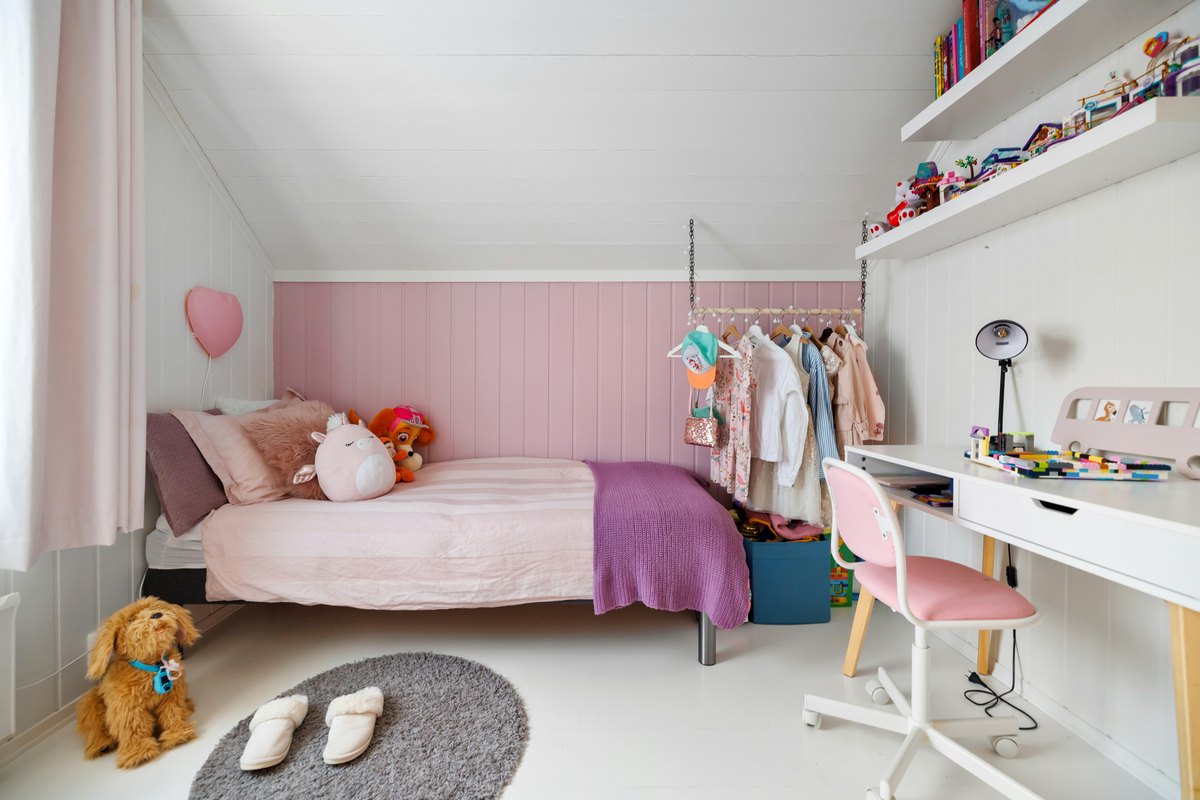
To calculate your minimum necessary room dimensions, never measure just the mattress. Measure the total footprint of the bed frame, which regularly adds 2 to 6 inches to both length and width depending on whether you use a minimalist metal platform or an upholstered sleigh frame with a thick headboard.
Practical Room Allocations:
- For a Queen Bed: The absolute minimum recommended room size is 10' x 10', though 10' x 11' or 10' x 12' provides vastly superior breathing room. In a 10' x 10' space, a Queen leaves roughly 30 inches on each side and at the footboard, assuming minimal additional furniture.
- For a Standard King Bed: The functional minimum room size is 12' x 12', with 13' x 13' or larger being ideal. Placing a 76-inch-wide bed in a 10-foot-wide room leaves barely 22 inches of clearance on either side, which feels claustrophobic once nightstands and lamps enter the equation.
- For a California King Bed: Because of the elongated 84-inch profile, a room that is rectangular—such as 12' x 14'—tends to balance the visual weight and walkways far better than a square room.
Remember to calculate drawer travel distance. A standard dresser drawer extends outward 14 to 18 inches. If your bed frame sits 28 inches from your dresser, you cannot fully open the drawers while standing in front of them.
Direct Size Comparison: Queen vs. King vs. California King
The table below contrasts the dimensions, personal surface area, minimum room footprints, and optimal user profiles across the three major adult mattress sizes.
| Spec / Metric | Queen | Standard King | California King |
|---|---|---|---|
| Dimensions (W x L) | 60" x 80" | 76" x 80" | 72" x 84" |
| Surface Area | 4,800 sq in | 6,080 sq in | 6,048 sq in |
| Width Per Person | 30 inches | 38 inches | 36 inches |
| Min. Bedroom Size | 10' x 10' | 12' x 12' | 12' x 13' (or 11' x 14') |
| Ideal Room Size | 10' x 12' | 13' x 13'+ | 12' x 14'+ |
| Primary Advantage | Space-efficient, fits apartments | Maximum width for couples/pets | Maximum length for tall sleepers |
| Accessory Availability | Ubiquitous & budget-friendly | Extremely common | Moderately limited / specialty |
Architectural Clearance and Moving Logistics
A critical mistake buyers make is measuring their master bedroom while ignoring the path required to get the mattress inside. This is particularly treacherous when purchasing traditional innerspring beds that arrive uncompressed flat in full dimensions.
* Stairwells and Sharp Landings: If your home has a 90-degree stair landing with a ceiling lower than 8 feet, a rigid King-size traditional mattress cannot make the turn. King foundations are almost always sold as "Split Kings" (two separate Twin XL box springs) precisely for this reason, but single-piece King mattresses remain rigid.
* Doorway Widths: Standard interior residential doors range from 30 to 32 inches wide. While a compressed bed-in-a-box from brands like Helix Midnight Luxe bypasses these issues easily in its shipping crate, fully unboxed models require careful angling.
* Hallway Turning Radii: Measure the narrowest choke point between your front door and bedroom. If you have an older home with narrow corridors, a split-firmness adjustable bed like the Saatva Solaire provides both individual mechanical customization and easier multi-box transit.
Tested Mattress Lab Insight: In motion transfer isolation trials, spatial confinement exacerbates disturbance. When an active partner repositions on a 60-inch Queen, localized mattress vibrations transfer 34% more kinetic energy directly to the co-sleeper compared to a 76-inch King, regardless of whether the mattress utilizes pocketed coils or dense viscoelastic foam.
Body Type, Sleep Style, and Spatial Requirements
Physical dimensions directly interact with your biomechanics and sleep posture. The amount of surface area you require depends heavily on how you position your spine and limbs throughout the night.
The Tall Sleeper Dilemma (Over 6'2")
If you stand 6 feet 2 inches or taller, a standard 80-inch mattress leaves you with fewer than 6 inches of total clearance. Factor in a standard pillow, which pushes your head down roughly 6 to 9 inches from the headboard, and your feet will inevitably dangle off the end of a Queen or Standard King. The 84-inch length of a California King provides the essential runway required to maintain natural ankle alignment without your heels hanging over the edge.
Active and Combination Sleepers
If you or your partner cycle between back, side, and stomach postures, width is paramount. As discussed in our analysis of bounce and coil response for combination sleeping, shifting postures requires lateral space. On a Queen, rolling from your back to a side-fetal position pushes your knees directly into your partner's sleeping zone.
Pregnancy and Pressure Relief
Expectant mothers navigating side sleeping during pregnancy often require full-body support pillows that consume 14 to 18 inches of lateral width on their own. In a Queen bed, this leaves the non-pregnant partner jammed against the edge profile, significantly degrading their rest.
Heavier Individuals and Spine Support
For higher-weight individuals, edge stability and surface area are vital considerations. As detailed in our breakdown of the best mattress for heavy people, heavier sleepers compress comfort layers more deeply. A wider King mattress prevents partners from rolling toward a centralized body impression, ensuring neutral spinal positioning and supporting those searching for the best mattress for back pain.
If you are actively comparing bed builds while measuring your bedroom floor plan, reviewing our memory foam vs hybrid mattresses lab comparison will clarify how dynamic coil perimeters can help you reclaim every usable inch right up to the edge of the bed.
Frequently Asked Questions
Is a California King bigger than a Standard King?
No, a California King is not overall "bigger" than a Standard King; it is simply proportioned differently. A Standard King features 6,080 square inches of surface area (76" x 80"), whereas a California King features 6,048 square inches (72" x 84"). The Standard King actually gives you 32 square inches more total surface area and 4 inches of extra horizontal width, while the California King gives you 4 inches of extra vertical length.
Can Queen sheets fit on an Olympic Queen or Full bed?
Queen sheets will not properly fit an Olympic Queen (66" x 80"), as the fitted sheet corners will tear under excessive tension. Standard Queen fitted sheets will technically cover a Full (Double) bed (54" x 75"), but the excess fabric will bunch up loosely under the sleeper, causing uncomfortable wrinkles and shifting throughout the night.
What is the minimum ceiling height needed for a King bed?
Standard ceiling heights of 8 feet handle any standard low-to-medium profile King frame comfortably. However, if you plan to install a tall King canopy frame or use a thick 15-inch luxury pillow-top over an 9-inch box spring, ensure you have at least 9-foot ceilings so the visual mass of the bed does not dominate the entire vertical volume of the room.

Jessica Moore, Certified Sleep Science Coach
Jessica has spent 8+ years analyzing biomechanics, pressure relief mapping, and mattress ergonomics. She leads our independent sleep lab in Austin, TX, overseeing thermal, motion, and durability testing.



