
Key Takeaways
- Side sleepers perform best on 4.5–6.5/10 (Medium-Plush to Medium) to prevent shoulder and hip pressure buildup.
- Back sleepers require 6.0–7.5/10 (Medium-Firm) with active lumbar pushback to preserve the natural S-curve.
- Stomach sleepers should stay between 7.0–8.5/10 (Firm) to prevent pelvic sinkage and lower-back hyperextension.
- Every 50 lbs of body weight shifts perceived firmness by roughly 1 full point on the 10-point scale.
Walk into any mattress showroom or open five online mattress reviews, and you will see the exact same vague adjectives recycled endlessly: "Plush," "Luxury Firm," "Medium-Plush," "Universal Comfort." The problem is simple—there is no industry-wide legal standard behind any of those labels. One brand's "Medium" sinks like wet snow, while another brand's "Medium" feels as unyielding as a carpeted hardwood floor.
Inside our Austin sleep laboratory, we strip away marketing adjectives and calibrate every mattress we test on a standardized 1 to 10 firmness scale—where 1 feels like sinking deep into feather pillows and 10 feels like lying straight on oak flooring. More importantly, we pair subjective feel with high-resolution sensor pressure maps and body-weight benchmarks, because a mattress's real firmness depends heavily on how much weight and shape you put onto it.
Understanding the 1–10 Sleep Lab Firmness Scale
Before comparing positions, keep one foundational fact in mind: virtually no quality adult mattress falls at 1, 2, 9, or 10. Nearly 90% of sleepers perform best somewhere between 4.5 and 8.0 / 10:
- 3.0 – 4.5 (Plush / Soft): Deep initial hug and high shoulder sinkage. Ideal primarily for lightweight strict side sleepers under 130 lbs who barely compress standard foam layers.
- 5.0 – 5.5 (Medium-Soft): Balanced plush contouring with modest transition pushback. Suits average-weight strict side sleepers seeking extra joint cushioning.
- 6.0 – 6.5 (Medium to Luxury Firm): The true universal sweet spot—accommodates combination sleepers, average-weight couples, back sleepers, and most side sleepers (e.g., Helix Midnight Luxe at 6.0 and Saatva Classic Luxury Firm at 6.5).
- 7.0 – 8.0 (Firm): Minimal surface give and crisp upward support. Best suited for dedicated stomach sleepers, back sleepers over 200 lbs, and heavier adults needing deep pelvic lift (e.g., Nectar Classic Hybrid at 7.0).
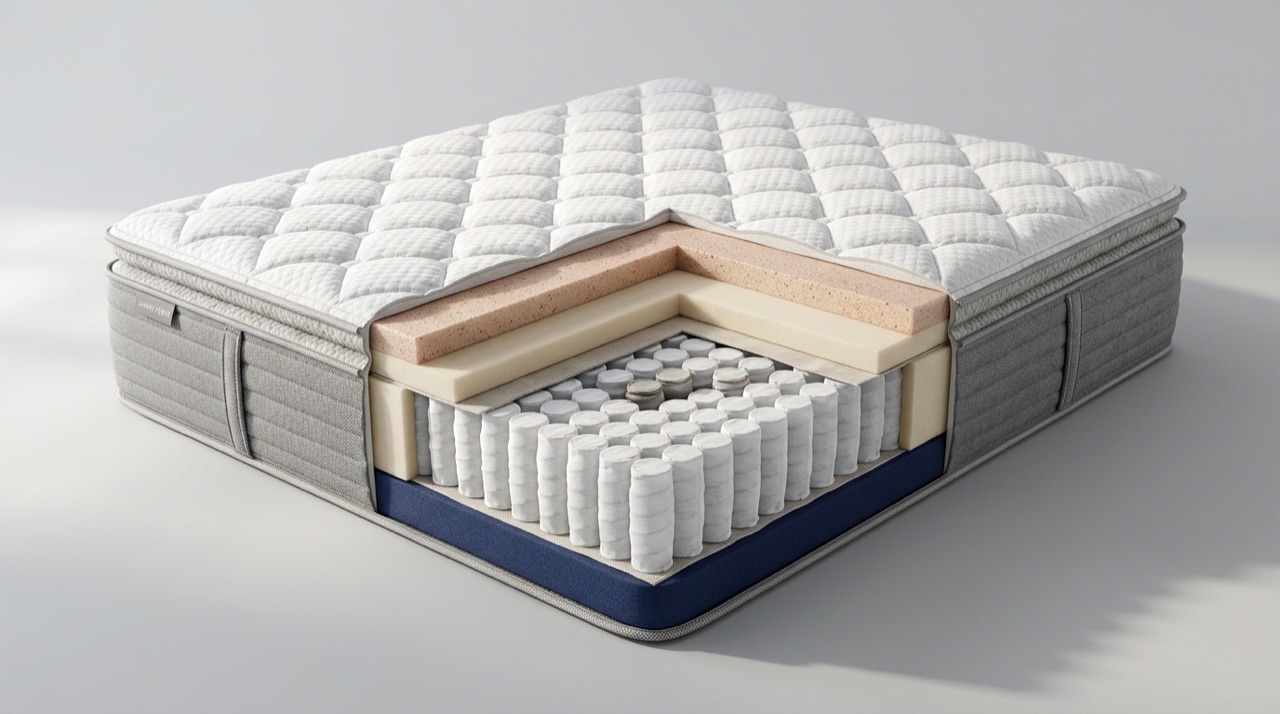
Sleep Lab Rule from Jessica Moore: Firmness and support are not the same thing. A cheap 4-inch foam topper over sagging coils feels soft and unsupportive, whereas a zoned hybrid feels plush on your shoulders while actively holding your lumbar spine straight.
Ideal Firmness Targets by Primary Sleeping Position
1. Side Sleepers: Target 4.5 – 6.5 / 10
Side sleeping concentrates nearly 70% of your upper-body mass onto the outer point of your shoulder and greater trochanter (outer hip bone). Once localized pressure crosses 30 mmHg, capillary blood flow compresses and triggers midnight arm tingling or hip soreness. Aim for at least 3 inches of forgiving top comfort layers—either zoned pocketed hybrids like Helix Midnight Luxe and Nolah Evolution 15, or deep contouring gel foam like Nectar Memory Foam. (Dive deeper in our Shoulder Numbness & Cushion Depth Guide.)
2. Back Sleepers: Target 6.0 – 7.5 / 10
Back sleeping distributes weight across a wide footprint, shifting the engineering challenge from sharp pressure points to active lumbar support. Too soft, and your heavier pelvis drops below your ribs, pulling lower vertebrae into painful curvature; too firm, and an empty air gap sits underneath your lower back. Dual-coil builds like Saatva Classic and sturdy Euro-top hybrids like DreamCloud Premier shine here.
3. Stomach Sleepers: Target 7.0 – 8.5 / 10
Lying face-down puts concentrated mass right at the belly and hips. On anything softer than 6.5/10, gravity bows your midsection downward into lower-back hyperextension. Stick to firmer, thinner-quilted beds such as Nectar Classic Hybrid, Saatva Classic Firm, or Bear Elite Hybrid Firm—and read our Stomach Sleeper Spine Guide.
4. Combination Sleepers: Target 6.0 – 6.5 / 10
Rotating between side, back, and stomach overnight demands fast coil responsiveness (9.2+ / 10) right around the 6.0–6.5 mark so turning over takes zero effort. (Compare rebound scores in our Combination Sleeping Guide.)
The Body-Weight Multiplier: Why 50 lbs Changes Everything
Reading a firmness number without accounting for body weight is the #1 reason people order the wrong mattress online. Foam resistance scales nonlinearly—meaning every 50 lbs of body mass shifts perceived firmness by roughly one full point:
| Sleeper Weight Bracket | How a "6.5/10 Medium-Firm" Feels | Recommended Target Range | Best Lab Construction Type |
|---|---|---|---|
| Lightweight (< 135 lbs) | Feels like 7.5 / 10 (noticeably firmer) | 4.5 – 6.0 / 10 | Plush Euro-top or soft foam tiers (3.5"+ top cushion) |
| Average Weight (135–230 lbs) | Feels right on target (6.0 – 6.5 / 10) | 5.5 – 7.0 / 10 | Zoned pocketed coil hybrid or high-density foam |
| Heavyweight (230+ lbs) | Feels like 5.0 – 5.5 / 10 (softer, deeper sink) | 6.5 – 8.0 / 10 | Thick 13.5"–15" heavy-gauge coil hybrids (Saatva Classic, DreamCloud Premier) |
How Couples With Different Preferences Compromises Work
When a 125-lb side sleeper shares a Queen with a 215-lb back sleeper, buying for only one person guarantees sore mornings for the other. Here are three practical compromises we recommend in our Best Mattresses for Couples testing:
- Choose a 6.0–6.5/10 Zoned Hybrid With Strong Edges: Beds like Helix Midnight Luxe give lightweight partners plush quilted comfort on top while thicker center-third coils stop heavier partners from sagging.
- Use a Thin Side-Only Topper on Split Foundations (or Twin XL Split King): Placing two separate Twin XL mattresses side by side inside one King frame lets each partner pick their exact firmness without compromising.
- Never Neglect Break-In Time: Fresh comfort foam routinely feels half a point to one full point firmer during week one before softening by 10%–15% across nights 14 to 30.
Frequently Asked Questions
How long should I test a new mattress before deciding it is too firm or too soft?
Give any brand-new mattress at least 21 to 30 consecutive nights. Both the quilted top fibers and your muscle memory (especially if you spent years adapting to a sagging old bed) need three weeks to calibrate accurately. Most brands build a mandatory 30-night break-in into their 100-to-365-night trial windows for this exact reason.
Can pillow height make a mattress feel firmer or softer?
Yes—an overly flat pillow lets side sleepers jam extra bodyweight straight down onto their lower shoulder, making a decent bed feel uncomfortably hard. See exact measurements in our Morning Neck Stiffness & Pillow Loft Guide.
Still unsure which number fits your exact weight and posture mix? Take our 60-second Sleep Match Quiz, explore Best Mattress 2026, or check verified promo discounts on Mattress Deals & Coupons.

Jessica Moore, Certified Sleep Science Coach
Jessica has spent 8+ years analyzing biomechanics, pressure relief mapping, and mattress ergonomics. She leads our independent sleep lab in Austin, TX, overseeing thermal, motion, and durability testing.



